

Report
Report
Employer gender pay gaps report 2024–25
The report provides benchmarks for the analysis of employer gender pay gaps and identifies three key areas where progress can accelerate. It is based on the data of 10,500 employers, representing the workplaces of almost 5.9 million Australians. The report finds that more employers have a gender pay gap in the target range.

Report
In the interest of fairness: a review into the ATO’s management of remission of general interest charge
A review into the Australian Taxation Office’s (ATO) decision making in relation to the general interest charges on tax debts. It found the ATO’s inconsistent decision-making, vague guidance and poor communication were leading to confusion and unfair outcomes for taxpayers seeking a remittance of the interest charges accumulating on tax debts. It made four recommendations.
Report
Snapshot of children and young people with disability in Australia
This report provides a comprehensive national overview of children and young people with disability in Australia aged 0–25. It draws on publicly available data to bring together evidence on demographics, early childhood, education, employment, health and wellbeing, housing and transport, income and finance, NDIS supports, safety and justice, and social and community participation nationwide contexts.
Report
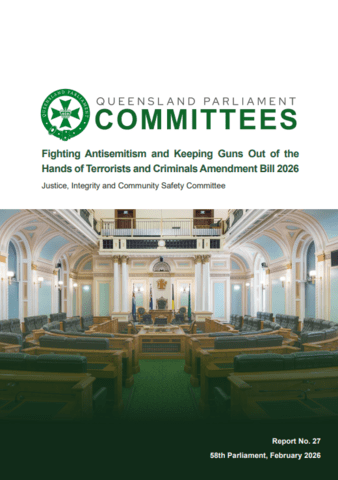
Fighting Antisemitism and Keeping Guns Out of the Hands of Terrorists and Criminals Amendment Bill 2026
This report presents a summary of an examination of Queensland's Fighting Antisemitism and Keeping Guns out of the Hands of Terrorists and Criminals Amendment Bill 2026. The committee’s task was to consider the policy to be achieved by the legislation and the application of fundamental legislative principles. The committee recommends that the Bill be passed.
Report
Perceived risk of victimisation by artificial intelligence enabled crimes
In the past 10 years, there has been a rapid proliferation of publicly available tools and applications using artificial intelligence (AI). Using Australian data, this report measured the perceived frequency of AI-enabled crimes and which specific technologies pose the greatest perceived risk of victimisation. The findings highlight priority areas for industry safeguards and public education.