

 SHARE
SHARE
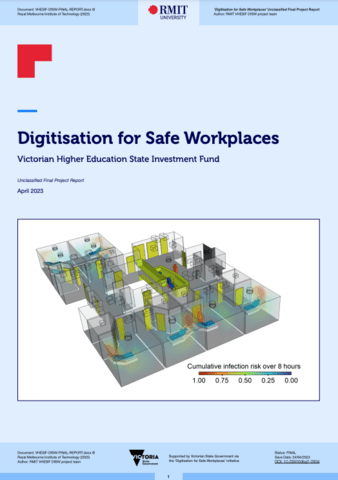
Digitisation for safe workplaces: final project report

This project aimed to develop an understanding of what controls the risk of airborne pathogen spread in workplaces and the effectiveness of various strategies to mitigate this risk.
The basic premise of the study was that a major transmission mode is via the transport of pathogenic aerosols expelled by infectious occupant/s in the workplace, such that the infection risk to others can be determined from cumulative exposure to the spatiotemporally varying concentration of these aerosols. The study concentrated on interactions between physical factors, i.e. building layout and the heating, ventilation and air conditioning (HVAC) system and its operational settings, along with human factors, i.e. the position and movement of a workplace’s occupants.
The study used sensors to characterise workplace airflow, particulate concentrations, indoor climate conditions, and human movement for five anonymised Victorian workplaces. These measurements formed inputs to computational fluid dynamics (CFD) models of airflow and aerosol transport within these five workplaces.
