

 SHARE
SHARE
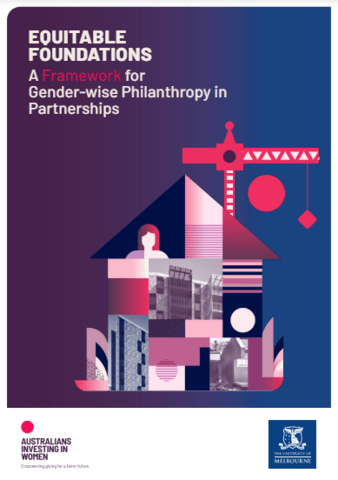
Equitable foundations: a framework for gender-wise philanthropy in partnerships
| Attachment | Size |
|---|---|
 Equitable foundations: a framework for gender-wise philanthropy in partnerships Equitable foundations: a framework for gender-wise philanthropy in partnerships
|
5.12 MB |
Philanthropy has the power to play a pivotal role in addressing complex challenges facing society. Increasingly, philanthropic funders recognise that this power can be amplified when they work in partnership and collaborate with other funders and key stakeholders to achieve an outcome that would not be possible alone.
Both Australians Investing In Women (AIIW) and the University of Melbourne’s Social Equity Institute (MSEI) understand the power of a gender lens to supercharge this impact further and to help ensure that philanthropic collaborations include and benefit all members of society equitably.
For this reason, the organisations teamed up to produce this evidence-informed, gender-wise practical resource and its underpinning report, enabled by funding from the Paul Ramsay Foundation.
The argument in favour of gender equality and its positive impacts on the wellbeing of societies, economies and our planet are well documented. Evidence both globally and locally indicates that among the many advantages, enhancing gender equality plays a crucial role in alleviating poverty and disadvantage. Despite this, significant and deeply rooted gender inequities and their associated impacts persist.
Federally, Australia has seen a strengthened commitment to gender equality through the 2023 Women’s Budget Statement, the establishment of the Women’s Economic Equality Taskforce, and through development of the National Gender Equality Strategy. This expectation of gender consideration flows into public and private partnerships which have become increasingly important in delivering projects in healthcare, education and infrastructure in recent times.
This framework provides a clear and practical roadmap, whether you are at the beginning of the gender-wise path or are more experienced in applying a gender lens to increase philanthropic impact and gender equity. Informed by case studies and broader sector expertise, the framework draws on experiences of funders and partners in projects supporting women’s housing to map out principles and pathways forward that can be applied to collaborations seeking to impact any social issue.
