

Sensitivity Warning
First Peoples
Aboriginal and Torres Strait Islander peoples should be aware that this resource may contain images or names of people who have since passed away.
Report
 SHARE
SHARE
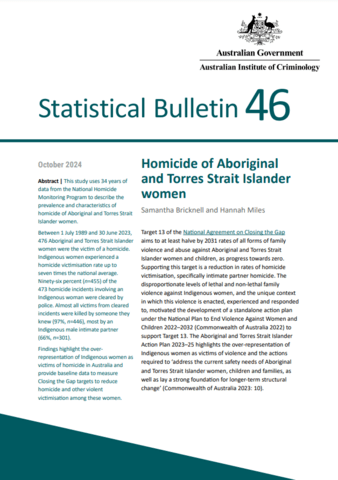
Homicide of Aboriginal and Torres Strait Islander women
Publisher
Aboriginal people (Australia)
Torres Strait Islander people
Homicide
First Nations women
Intimate Partner Violence (IPV)
Gender-based violence
Australia

Description
This study uses 34 years of data from the National Homicide Monitoring Program to describe the prevalence and characteristics of homicide of Aboriginal and Torres Strait Islander women, finding Indigenous women experienced a homicide victimisation rate up to seven times the national average.
These data complement the findings from the currently small number of studies about the homicide of Indigenous women and contribute long-term data with which to measure national targets to reduce rates of victimisation and eliminate the circumstances that initiate lethal violence.
key findings
- Between 1 July 1989 and 30 June 2023, 476 Aboriginal and Torres Strait Islander women were victims of homicide.
- 96% of the 473 homicide incidents involving an Indigenous woman were cleared by police.
- 97% of victims from cleared incidents were killed by someone they knew.
- 72% of Indigenous women were killed by a current or former male intimate partner, with smaller proportions killed by another family member or a friend or acquaintance (13% each).
- 92% percent of the male intimate partner offenders were also Indigenous.
- The homicide of Indigenous women mostly occurred in a private residence, although over a third took place in a community setting, specifically an open area or streetscape. This pattern differs from homicide generally, which less commonly occur in public locations.
- Around half of the homicides were immediately preceded by some form of domestic conflict or enmity.
Publication Details
DOI:
10.52922/sb77604
ISBN:
9781922877604
Copyright:
Australian Institute of Criminology 2024
Access Rights Type:
open
Series:
AIC Statistical Bulletin 46
Post date:
1 Oct 2024
