

Briefing paper
 SHARE
SHARE
What if we didn't care? Implications of growth in the care economy for the broader macroeconomy
Publisher
Labour mobility
Care economy
Labour force productivity
National Disability Insurance Scheme (NDIS)
Australia

Description
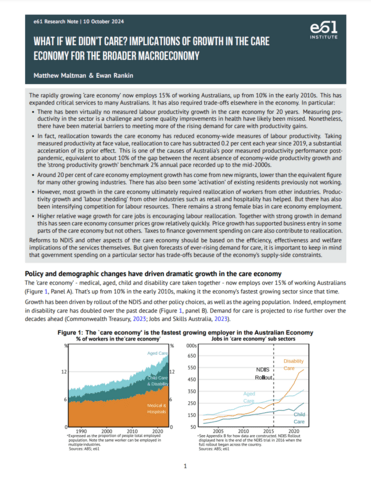
This paper provides an analysis of structural problems the economy is facing as a result of the rapid expansion of the care sector, which now employs 15 per cent of Australia’s workforce – up from 10 per cent in the early 2010s. The authors observe that growth in the care economy has not been assisted by productivity growth but has relied instead on labour reallocation and new migrant workers, destabilising the wider economy.
The rapidly growing ‘care economy’ has expanded critical services to many Australians, but has also required trade-offs elsewhere in the economy.
Key points
- Reforms to NDIS and other aspects of the care economy should be based on the efficiency, effectiveness and welfare implications of the services themselves.
- There has been virtually no measured labour productivity growth in the care economy for 20 years.
- Reallocation towards the care economy has reduced economy-wide measures of labour productivity.
- Around 20 per cent of care economy employment growth has come from new migrants, lower than the equivalent figure
for many other growing industries. - Most growth in the care economy ultimately required reallocation of workers from other industries.
- There remains a strong female bias in care economy employment.
- Higher relative wage growth for care jobs is encouraging labour reallocation, together with strong growth in demand
this has seen care economy consumer prices grow relatively quickly.
Publication Details
Copyright:
e61 Institute 2024. Reproduced with permission.
License type:
All Rights Reserved
Access Rights Type:
open
Post date:
10 Oct 2024
