

Briefing paper
 SHARE
SHARE
Child care and maternal labour supply: lessons from the 2018 child care reforms
Publisher
Labour force participation
Mothers and employment
Government subsidies
Child care assistance
Policy reform
Child care
Australia

Description
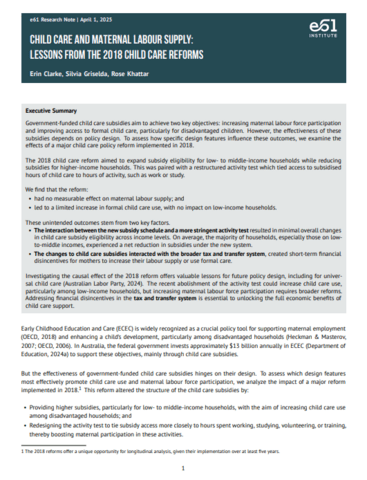
Government-funded child care subsidies aim to achieve two key objectives: increasing maternal labour force participation
and improving access to formal child care, particularly for disadvantaged children. However, the effectiveness of these
subsidies depends on policy design. This paper examined the effects of a major child care policy reform implemented in 2018.
The 2018 child care reform aimed to expand subsidy eligibility for low- to middle-income households while reducing subsidies for higher-income households. This was paired with a restructured activity test which tied access to subsidised hours of child care to hours of activity, such as work or study.
The paper finds the reform:
- had no measurable effect on maternal labour supply; and
- led to a limited increase in formal child care use, with no impact on low-income households.
Publication Details
Copyright:
e61 Institute 2025. Reproduced with permission.
Access Rights Type:
open
Post date:
2 Apr 2025
