

Organisation
OECD Publishing
Owning Institution:
Report
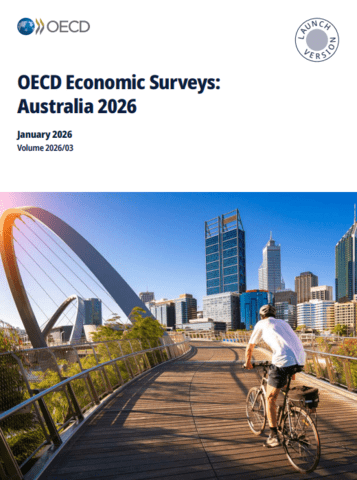
OECD economic surveys: Australia 2026
This snapshot offers an overview of Australia's economic situation, GDP and inflation projections, growth prospects and structural reform priorities. It highlights major economic trends and key policy recommendations for sustainable and inclusive growth. It includes a special feature on revitalising competition in the Australian economy.

Report
OECD digital education outlook 2026
Generative AI (GenAI) is reshaping the educational landscape. This outlook analyses research that suggests GenAI can support learning when guided by clear teaching principles. However, without pedagogical guidance, outsourcing tasks to GenAI enhances performance with no real learning gains. The outlook synthesises evidence and insights on the design criteria that make it work for education.
Report
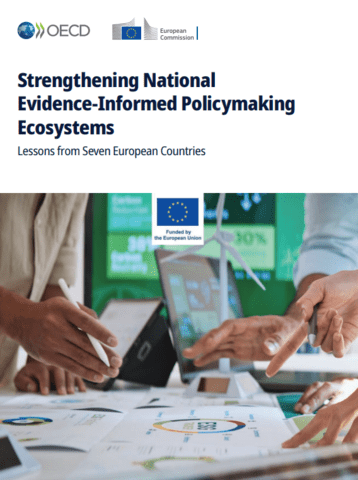
Strengthening national evidence-informed policymaking ecosystems
This report synthesises the findings of a project to help seven European countries build capacity for evidence-informed policymaking (EIPM) in governance and public administration. It identifies pathways for promoting EIPM across Europe to address Europe’s most pressing challenges, respond to the changing needs of governments, and strengthen the capacity and resilience of public administrations with...
Report
Budget offices and line ministries
The relationship between budget offices and line ministries is evolving across OECD countries. Effective budgeting now depends on strong internal finance functions within line ministries, collaborative engagement across the budget cycle, and sustained investment in skills and systems. This paper discusses how this partnership can be strengthened to ensure budgeting supports fiscal sustainability.
Working paper
Unleashing the policy potential of rigorous impact evaluation and randomised trials
This report explores how governments can overcome barriers to deliver high-quality impact evaluations to contribute to policy development. It sets out the main evaluation methods available, ranging from randomised trials to quasi-experimental approaches, and highlights the conditions under which each can be applied.