

Disability awareness
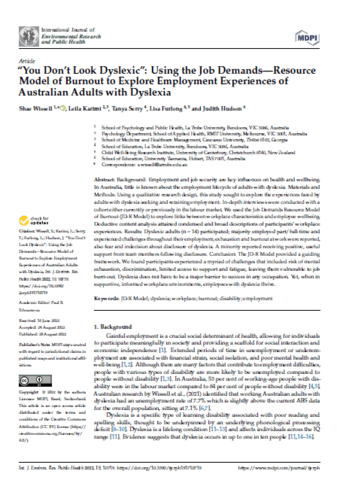
Journal article
“You don’t look dyslexic”: using the Job Demands—Resource Model of Burnout to explore employment experiences of Australian adults with dyslexia
This study sought to explore the experiences faced by adults with dyslexia in seeking and retaining employment. The findings indicate participants experienced challenges including mental exhaustion, discrimination, limited access to support and fatigue, leaving them vulnerable to job burn-out. Informed workplace environments are needed to help employees with dyslexia thrive.

Strategy
Northern Territory disability strategy 2022–2032
This strategy was developed with expertise from the Disability Advisory Committee (NT) and community input, including from those with lived experience of disability, taking into account their families, carers and significant others, government and non-government services. The strategy and three-year action plan is the first of its kind for the Territory.

Report
People with disability in Australia 2022
People with disability in Australia brings together information from a range of national data sources to contribute to a greater understanding of disability in Australia. The 2021–22 update expands the report to include new reporting of data disaggregated by age group, disability group and remoteness.

Guide
A guide to classifying employment supports
The Typology of Employment Support Interventions (TESI) provides a shared language and method for conceptualising, designing, commissioning, selecting and evaluating employment supports for people experiencing injury, illness or disability. This guide explains the purpose of the TESI, and suggests ways to use it for funders, employment service providers, users and researchers of employment supports.

Conference paper
Beyond ‘mobility reductionism’: striking new paradigms for the wellbeing of Wheeled Mobility Device (WMD) users in the public realm
This presented paper is an exercise in reforming policy planning on disability and ensuring the participation of WMD users in communities. It is critical of the conventional placemaking approaches that focus solely on meeting mobility needs and are ‘mobility reductionist’.