

Behavioural insights
Report
Motivating action: closing the gender pay gap in Victorian businesses
This research explores new frontiers in gender equity research by focusing on motivational factors and behavioural insights to understand why businesses, particularly small businesses, may act (or not) to close the gender pay gap and to tailor policy tools. The report offers a firm-level analysis of the gender pay gap and investigates how cultural norms...
Policy report
Fixing frictions: ‘sludge audits’ around the world
Behavioural science research and practice are increasingly identifying ways in which government processes are hindering equitable and efficient access to programs and the policy benefits they deliver. This paper delineates good practice principles, derived from ten case studies, aimed at promoting the integration of 'sludge' audit methodologies into public governance and service design.
Guide
LOGIC: Good practice principles for mainstreaming Behavioural Public Policy
This guide outlines 14 good practice principles to encourage the incorporation of behavioural perspectives into policy-making. Whereas traditional policy analysis methods make assumptions about people and their behaviour which may not be true in practice, a behavioural lens equips policy-makers with a more realistic understanding of how people interact with each other and institutions.
Policy report
Demand-side policy measures for environmental sustainability
This paper addresses demand-side policy measures to improve environmental sustainability. It outlines the potential of such measures, and presents relevant findings from the cross-country OECD 'Survey on Environmental Policies and Individual Behaviour Change' (EPIC) on the main barriers that households face in adopting sustainable behaviours.
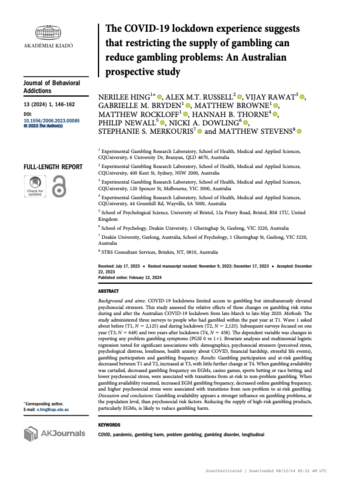
Journal article
The COVID-19 lockdown experience suggests that restricting the supply of gambling can reduce gambling problems: an Australian prospective study
This article reports on a study that assessed people's gambling during and after the Australian COVID-19 lockdown. It found that gambling availability appears a stronger influence on gambling problems than psychosocial risk factors. Reducing the supply of high-risk gambling products is likely to reduce gambling harm.