

Family dynamics
Alternative labels
Family life
Video
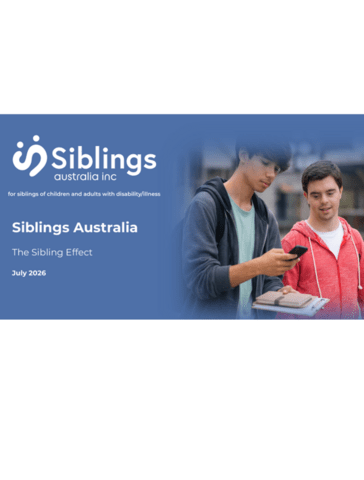
Lunch & learn: the sibling effect
Siblings are often one of the longest relationships in the life of a person with disability, yet they remain largely invisible within service systems. This recorded webinar explores the evidence behind sibling relationships and their unique contribution to employment outcomes.
Briefing paper
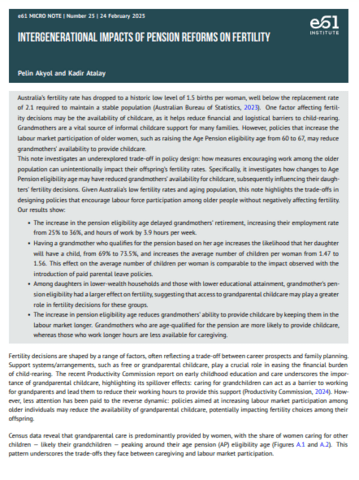
Intergenerational impacts of pension reforms on fertility
This paper investigates an underexplored trade-off in policy design: how measures encouraging work among the older population can unintentionally impact their offspring’s fertility rates. It finds that the unintended impact on the birth rate is comparable to that observed with the introduction of paid parental leave policies.
Working paper
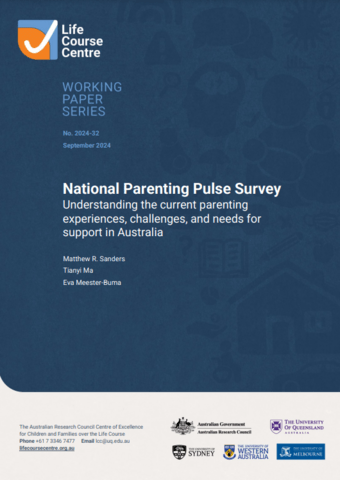
National Parenting Pulse Survey
To inform policy, research, and service delivery, a large-scale, National Parenting Pulse Survey captured the most up-to-date parenting experiences, challenges, and needs of parents in Australia. The survey revealed an ongoing requirement for support for parental mental health and self-care, and specific resources to address parents’ concerns about the negative effects of social media use...
Working paper
Land of the (un)fair go? Peer gender norms and gender gaps in the Australian labour market
Australian attitudes towards women remain more conservative than in many other OECD countries. This study uses directly assessed normative attitudes, based on nearly two decades of nationally representative household survey data, to consider the role played by peer gender norms.
Working paper
Family size and domestic violence in a high-fertility society
Does family size affect the prevalence of domestic violence? Using nationally representative survey data from Samoa, which has among the world’s highest fertility rates, the author extends the classic work on child quantity-quality trade-offs to also consider domestic violence.