

Communities
Presentation
'Her beauty and her terror - the wide brown land for me!' The individual and family wellbeing of Australian rural and regional families in drought
The most recent drought has been one of the most severe on record with large parts of southern and eastern Australia experiencing dry conditions since 1996. Moreover, 'For the agriculturally important Murray- Darling Basin, however, October 2007 marks the sixth anniversary of lower than average rainfall totals, with the November 2001 to October 2007 period...
Report
Where does the buck stop? Community attitudes to over-lending and over-spending
Australia's love affair with easy credit has turned on itself. In early 2008, the price of credit reached its highest point in 14 years, following 12 successive interest rate rises since 2001. With the domestic economy overheating, and home buyers feeling the economic pain associated with higher interest rates and inflation, consumer debt has become...
Strategy
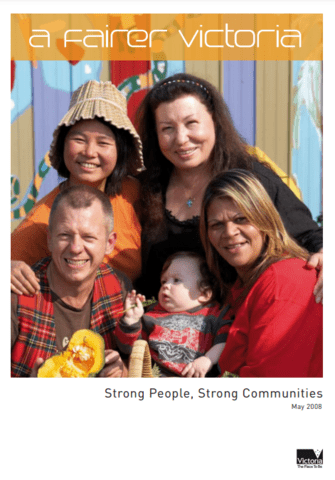
A fairer Victoria: strong people, strong communities
A Fairer Victoria is a whole of Government social policy action plan to address disadvantage and promote inclusion and participation. The plan targets four priority areas: support for children in their early years and for families most at risk; development of education and vocation; reducing health inequalities; promoting wellbeing; and strengthening neighbourhoods and local communities.
Report
Partnerships advancing community engagement: four pilot projects with Rotary
The Partnerships Advancing Community Engagement program (PACE) was devised by Rotary Youth Ambassadorial Scholar, Courtney Scala, during an internship with the Brotherhood of St Laurence. This innovative approach is about Rotary clubs collaborating with community members and agencies on long-term sustainable projects to address disadvantage. This review of four projects undertaken in Melbourne shows how...
Report
The challenge of 'closing the gaps' in Indigenous socioeconomic outcomes
This briefing paper, prepared for the Australia 2020 Summit, examines trends and predictions for key Indigenous socioeconomic indicators using census data from 1971 to 2006, and projects current trends forward to 2041.