

Acquired brain injury
Alternative labels
ABI
Traumatic brain injury
Journal article
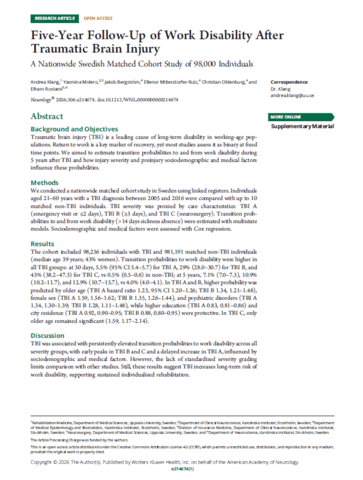
Five-year follow-up of work disability after traumatic brain injury
This study estimates transition probabilities to and from work disability during the years after traumatic brain injury and how injury severity and pre-injury sociodemographic and medical factors influence these probabilities. Findings suggest traumatic brain injury increases long-term risk of work disability, supporting sustained individualised rehabilitation.
Journal article
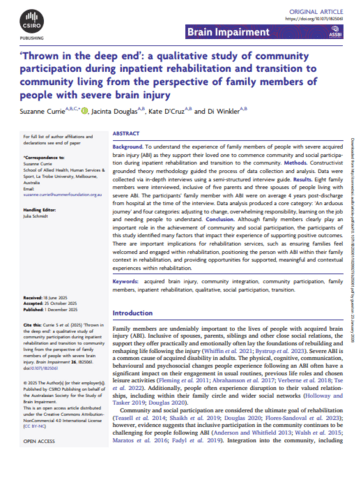
‘Thrown in the deep end’: a qualitative study of community participation during inpatient rehabilitation and transition to community living from the perspective of family members of people with severe brain injury
Family members are undeniably important to the lives of people with acquired brain injury (ABI). This study sought to understand the experience of family members of people with severe ABI, based in Australia, as they support their loved one to commence community and social participation during inpatient rehabilitation and transition to the community.
Journal article
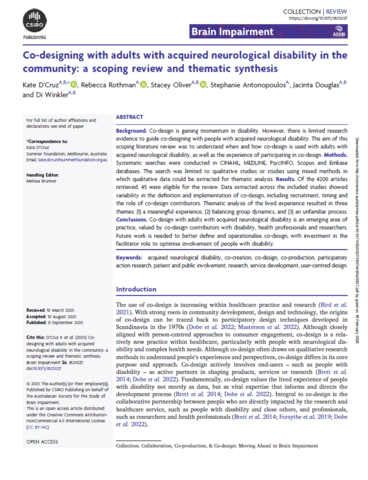
Co-designing with adults with acquired neurological disability in the community: a scoping review and thematic synthesis
This scoping review examines how and when co‑design is used with adults with acquired neurological disability and their lived experience. It finds co‑design remains under‑researched and underutilised, yet is meaningful, supporting participation, connection, belonging and learning. Future work should better define co‑design and invest in facilitation roles.
Journal article
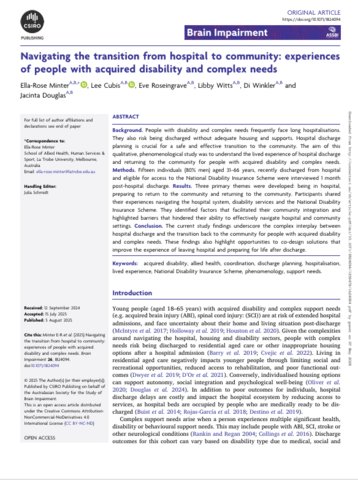
Navigating the transition from hospital to community
This article describes the findings from 15 interviews on the lived experience of hospital discharge and returning to the community for people with acquired disability and complex needs in the Australian context. It identifies opportunities to co-design solutions that improve the experience of leaving hospital for this group.
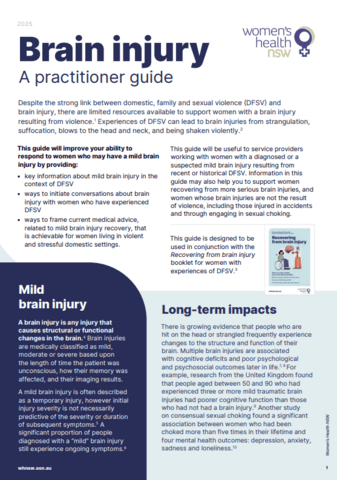
Guide
Brain injury: a practitioner guide
This practitioner guide is designed to support service providers to contextualise medical information about brain injuries for women living in violent and stressful domestic settings. It aims to improve a practitioner's ability to respond to women who may have a mild brain injury by providing: key information about mild brain injury in the context of...