

Acquired brain injury
Alternative labels
ABI
Traumatic brain injury
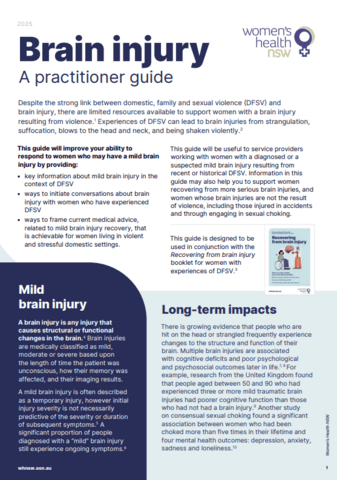
Guide
Brain injury: a practitioner guide
This practitioner guide is designed to support service providers to contextualise medical information about brain injuries for women living in violent and stressful domestic settings. It aims to improve a practitioner's ability to respond to women who may have a mild brain injury by providing: key information about mild brain injury in the context of...

Report
Moving out, moving on: beyond group homes for NDIS participants
Group homes for people with disability are a major source of financial pressure on the National Disability Insurance Scheme (NDIS), with Supported Independent Living (SIL) costs increasing by 28% over the past five years. Providers are struggling to maintain the viability of the service model. This report finds increasing Individualised Living Arrangements (ILAs) could save...
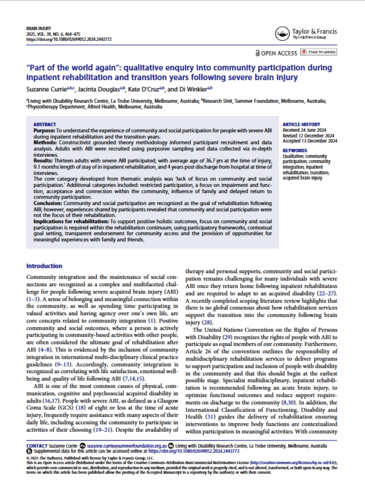
Journal article
“Part of the world again”: qualitative enquiry into community participation during inpatient rehabilitation and transition years following severe brain injury
This study explores how adults with severe acquired brain injury experienced community and social participation during rehabilitation and the transition back to community life. It found these goals were not prioritised, despite their importance, leading to missed opportunities to prepare people for life beyond hospital and limiting their ability to reconnect with community and resume...
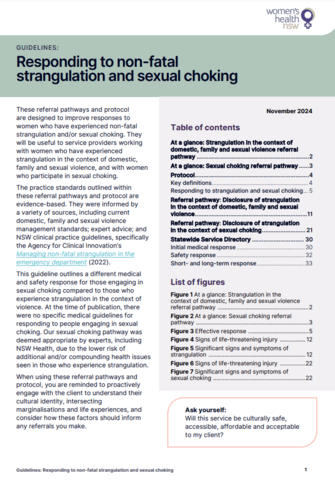
Guide
Responding to non-fatal strangulation and sexual choking
These guidelines are designed to improve responses to women with experiences of non-fatal strangulation and sexual choking. They were created to support the network of women’s health centres across NSW to develop their own organisational protocol and referral pathways for responding to women who have experienced non-fatal strangulation and sexual choking.
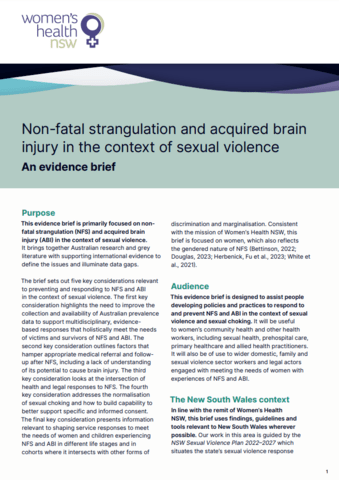
Briefing paper
Non-fatal strangulation and acquired brain injury in the context of sexual violence
This evidence brief is focused on non-fatal strangulation (NFS) and acquired brain injury (ABI) in the context of sexual violence. It brings together Australian research and grey literature with supporting international evidence to define the issues and illuminate data gaps. It will be useful to people developing policies and practices to respond to and prevent...