

Evidence-based policy
Alternative labels
Evidence-informed policy

Report
Every day counts: understanding, preventing and responding to school attendance problems
School attendance problems are no longer a marginal issue. This report synthesises evidence from an OECD survey, literature and international large-scale assessments to outline drivers and consequences of school absences. It takes stock of policies and practices for supporting school attendance and distils key messages and policy pointers emerging from the evidence presented.
Journal article
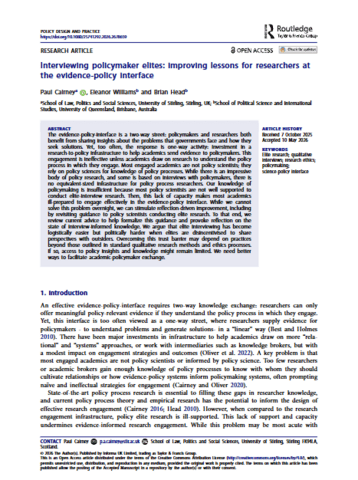
Interviewing policymaker elites: improving lessons for researchers at the evidence-policy interface
The evidence-policy-interface is a two-way street: policymakers and researchers both benefit from sharing insights about the problems that governments face and how they seek solutions. Yet, too often, the response is one-way activity. This article argues that elite interviewing has become logistically easier but politically harder when elites are disincentivised to share perspectives with outsiders.
Guide
Magenta Book: central government guidance on evaluation – May 2026
This guide is the 2026 update to the Magenta Book, the United Kingdom Government’s central guidance on evaluation. It provides guidance on scoping, design, conduct, use and dissemination as well as the capabilities required of government evaluators. The revised guide introduces several new and significantly expanded areas of focus to support high-quality evaluation across government.

Discussion paper
Artificial intelligence and evidence-informed policy – emerging challenges and opportunities: discussion paper
This discussion paper examines the intersection of artificial intelligence (AI) and evidence-informed policymaking, outlining how AI can support problem identification, policy design and implementation. It emphasises that AI augments rather than replaces human judgement, while highlighting its potential to expand the evidence base and support more timely, responsive decision-making in complex health contexts.
Discussion paper
Capturing the economic value of psychosocial support: a discussion paper
This discussion paper examines psychosocial support in Australia’s mental health system and the economic evidence of its impact. While emerging findings indicate mental, social, and economic benefits, robust evaluation remains limited. Gaps include definitions, frameworks, and system-level data. The paper calls for investment in measurement, mapping, and economic evaluation to strengthen evidence and inform reform.