

STEM education
Alternative labels
Science technology engineering and mathematics education
Engineering students
Mathematics study and teaching
Report
The role of the resources sector in harnessing and developing Australian STEM capability
As the resources sector undergoes a structural evolution, this research outlines key workforce demands, demographics and mobility trends. It demonstrates how the sector can lift Australia’s broader science and industrial capability by developing talent and building a workforce with expertise across a range of science, technology, engineering and mathematics disciplines.
Working paper
Gender differences in university enrollment and STEM Major
This research was undertaken to better understand the changing patterns of gender differences in Australian higher education. It provides insight into how educational decisions reinforce broader inequalities in economic outcomes. The findings demonstrate that tuition policy is not gender neutral. For policymakers, this highlights the importance of considering gender-specific incentives when designing tuition structures and...
Report
Australian science, Australia’s future: science 2035
This report examines the capability of Australia’s science system, its ability to compete and collaborate globally, and its contribution to the nation’s economy, security, health and quality of life. An investigation of scientific capability needs by 2035 found Australia has gaps – in workforce, infrastructure and coordination – that will cripple its ability to meet...
Report
STEM Equity Monitor: data report 2025
The STEM Equity Monitor reports on the state of science, technology, engineering and mathematics (STEM) equity in Australia, and measures changes and trends over time. The monitor follows the participation pathway in STEM through schooling, higher education, graduate outcomes and the workforce. The 2025 edition is expanded beyond gender to also include other diverse groups.
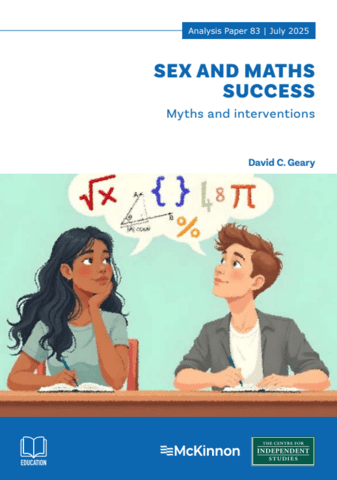
Report
Sex and maths success: myths and interventions
This report outlines sex differences in mathematics outcomes in primary and secondary school education. It looks into spatial competency, non-cognitive contributors and in-class attentive behaviour on these sex differences. The implications and interventions are examined, including Science, Technology, Engineering and Mathematics (STEM) policies for the future.