

Amenity
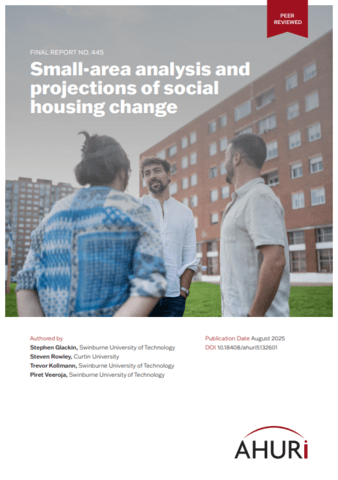
Report
Small-area analysis and projections of social housing change
This report explores concentrations and density of social housing relative to local amenities and services across Australia – providing an overview of the distribution, access and value of social housing stock. The research also developed an Amenity Index. The research demonstrates the need for more social housing with good access to local amenities.

Report
The Activity Centre Program is redistributive
The Victorian Government has been releasing more details about their housing policy: the Train and Tram Zone Activity Centres. This paper explores the program in the context of equity. It finds that through a focus on building in established areas, the program is an opportunity to redistribute wealth and means to a greater number of...

Strategy
Mparntwe/Alice Springs Social Order Response 2022-2023
The Northern Territory Government, in partnership with Lhere Artepe, the Alice Springs Town Council and the Chamber of Commerce are implementing a range of measures to support the community and improve social outcomes. This response focuses on three key areas to improve safety, support stronger families and engage young people.
Working paper
Provision of urban environmental amenities: a policy toolkit for inclusiveness
Environmental amenities provide a range of direct and indirect benefits in cities, and amenity provision often figures within policy portfolios to advance sustainability in urban areas. This report synthesises empirical research on the impact of environmental amenities on housing prices, examines implications on housing affordability, and offers perspectives on how negative impacts can be mitigated.
Conference paper
Calculation of policy-relevant spatial indicators of urban liveability: experiences of scaling a research programme from local to global
A pilot project, which focused on Melbourne in 2012, developed an initial workflow to calculate address-level liveability measures. This paper reviews methodological challenges encountered in the scaling up of this 5-year collaborative research program.