

Technology 2024

Back to Top Content
Built Environment Communications Culture Economics Education Environment First Peoples Government Health International relations Justice National security Science Social issues Technology
-
 Report
GenAI concepts: technical, operational and regulatory terms and concepts for generative artificial intelligence (GenAI)
Generative AI products and services have sparked substantial interest in the private and public sectors. To help entities interested in GenAI deployments, this publication outlines 42 concepts fundamental to AI software systems. Each concept is illustrated through descriptions, examples and real-world use cases, with accessible language and visual elements to accommodate a diverse range of... -
 Report
Making the most of the AI opportunity
In this set of three papers, the Productivity Commission places Australia’s artificial intelligence (AI) opportunity in a global context, to consider how Australian governments can help to maximise the potential economic benefits of this evolving technology. -
 Report
Building a trauma-informed algorithmic assessment toolkit
Building on work in social services on trauma-informed practice, the research behind this report identified key principles and a practical framework that framed AI design, development and deployment as a reflective, constructive exercise that results in algorithmic supported services to be cognisant and inclusive of the diversity of human experience, particularly those who have experienced... -
 Report
United against algorithms: a primer on disability-led struggles against algorithmic injustice
This research explores how people with disability are collectively responding to the threats posed by algorithmic, data-driven systems - specifically their public sector applications. -
 Submission
Safe and responsible AI in Australia: proposals paper for introducing mandatory guardrails for AI in high-risk settings
Daniel Angus, Francesco Bailo, José-Miguel Bello y Villarino, Jake Goldenfein, Paul Henman, Fabio Mattioli, Rita Matulionyte, Anthony McCosker, Luke Munn, Christine Parker, Lyndal Sleep, Milica Stilinovic, Johanne Trippas
This paper argues that the AI Guardrails proposed by the Australian Government are not a complete answer to how, as a society, we will manage AI risks, but they are an important step, and one that can be taken now. The paper also presents arguments in favour of a central AI body such as a... -
 Report
Synthetic politics: preparing democracy for Generative AI
Kiran Basavaraj, Hannah Perry
This report explores how synthetic content produced by Generative AI poses risks to the core democratic values of truth, equality, and non-violence. It proposes two action plans for what private and public decision-makers should be doing to safeguard democratic integrity immediately, and in the long run. -
 Report
Workplace technology-facilitated sexual harassment: perpetration, responses and prevention
Ever evolving technologies in the workplace create new mediums for sexual harassment, and employers and staff need support on how to prevent and respond to the potential harms. This research offers crucial insights to aid Australian employers and policy-makers in understanding and combating workplace technology-facilitated sexual harassment (WTFSH) effectively. -
 Guide
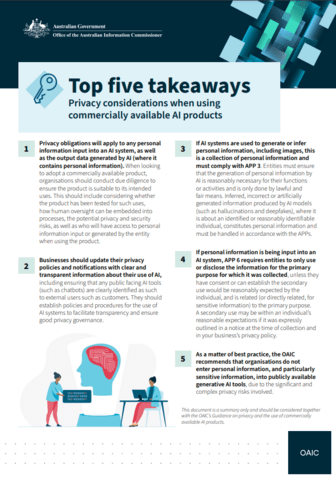
GuideGuidance on privacy and the use of commercially available AI products
This guidance is intended to assist organisations to comply with their privacy obligations when using commercially and freely available AI products, in particular generative and general-purpose AI tools. Overall, it is recommended organisations do not enter personal information into publicly available generative AI tools due to the significant and complex privacy risks involved. -
 Guide
GuideVoluntary AI safety standard
This voluntary standard helps organisations develop and deploy artificial intelligence (AI) systems by giving practical guidance on how to safely and responsibly use AI. The standard consists of ten voluntary guardrails that apply to all organisations throughout the AI supply chain. -
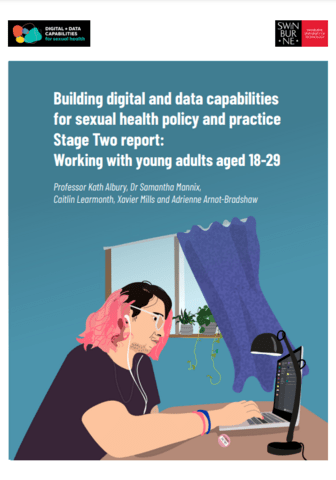 Report
Building digital and data capabilities for sexual policy and practice stage two report
Caitlin Learmonth, Xavier Mills, Adrienne Arnot-Bradshaw
This report outlines the digital and data capabilities the sexual and reproductive health workforce needs and examines how leaders across the sector can best support digital transformation at the organisational level.