

 SHARE
SHARE
Online Safety Amendment (Social Media Minimum Age) Bill 2024: bill digest
| Attachment | Size |
|---|---|
 Online Safety Amendment (Social Media Minimum Age) Bill 2024: bill digest Online Safety Amendment (Social Media Minimum Age) Bill 2024: bill digest
|
261.28 KB |
An overview and analysis of the Bill that proposes to amend the Online Safety Act 2021 to introduce a minimum age of 16 for social media use in Australia. The age restrictions will not commence for at least 12 months and although the bill has bipartisan support, experts and researchers in relevant fields have encouraged the government to pursue alternative action.
The paper examines the context, key provisions, and potential implications of the bill, highlighting areas of debate and concern. It explores the rationale behind the Bill, including the perceived harms of social media for children, and examines the proposed mechanisms for implementation and enforcement, including the role of age verification technology and the eSafety Commissioner.
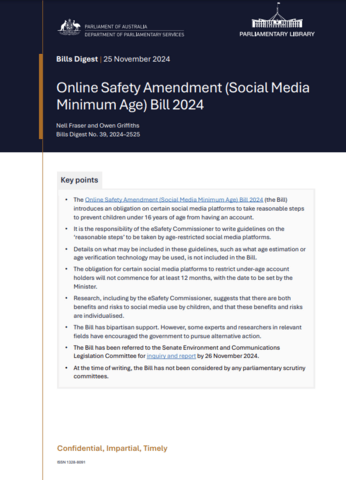
Key points
- The bill proposes a minimum age of 16 for social media use in Australia, applying to a broad range of platforms defined as "age-restricted social media platforms" (ARSMPs).
- The Minister for Communications will have the power to legislate which platforms are considered ARSMPs.
- The bill does not prescribe specific age verification methods, leaving it to the eSafety Commissioner to develop guidelines on "reasonable steps" for platforms to take.
- The obligation for certain social media platforms to restrict under-age account holders will not commence for at least 12 months, with the date to be set by the Minister.
- Research, including by the eSafety Commissioner, suggests that there are both benefits and risks to social media use by children, and that these benefits and risks are individualised.
- The Bill has been referred to the Senate Environment and Communications Legislation Committee for inquiry and report by 26 November 2024.
- At the time of writing, the Bill has not been considered by any parliamentary scrutiny committees.
- An independent review of the legislation is required within two years of its implementation.
