

 SHARE
SHARE
OECD employment outlook 2025: can we get through the demographic crunch?
| Attachment | Size |
|---|---|
 OECD employment outlook 2025 OECD employment outlook 2025
|
6.9 MB |
|
OECD employment outlook 2025: Australia
|
434.16 KB |
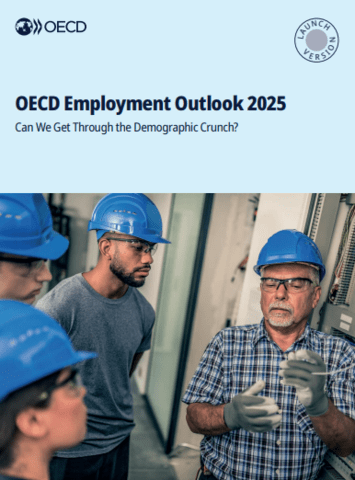
The OECD Employment Outlook looks at the latest labour market developments and prospects in OECD member countries. This edition discusses the enormous challenges population ageing poses to living standards and social cohesion more generally. The consequences of an ageing workforce for productivity growth are also analysed. Policies to address these demographic changes are analysed. The first chapter assesses recent labour market and wage developments.
As baby-boomers exit the labour market, the working age population in OECD countries is now starting to decrease, and is projected to continue to fall through to 2060. Meanwhile, the old-age dependency ratio – defined as the ratio of individuals aged 65 years and above to the working-age population – has soared and will continue to grow in the future.
The impact of ageing populations threatens the very engine of economic growth, which depends on human resources to produce output. The economy of OECD countries has entered a new era, where the challenge shifts from a shortage of jobs to a shortage of workers. Alongside climate change and digital revolution, the ageing of OECD economies is the third, and what might be called 'forgotten,' megatrend that requires the full attention of policymakers.
Without swift changes in policies and behaviours, GDP per capita growth will slow down significantly in most OECD countries. Integrating under-represented groups in the labour market will help offset ageing, in particular older workers and, in many countries, women who are currently not working or working few hours.
The report is accompanied by a country note on Australia.
