

 SHARE
SHARE
Beyond output per hour: productivity measurement in an AI-driven economy

The global productivity landscape is shifting rapidly, driven by technological disruption, the rise of data and AI, and the growing economic value of care and human services. The way goods and services are produced, and the nature of inputs into value creation, has changed fundamentally. To remain competitive and build a resilient, inclusive economy, Australia must modernise its productivity frameworks to reflect these transformations.
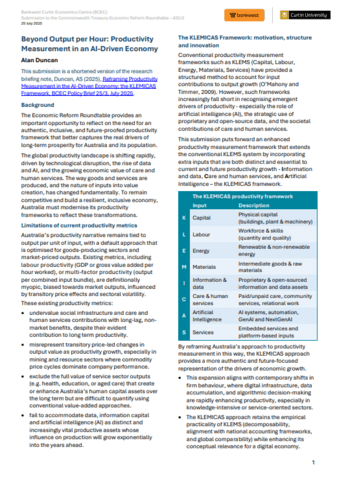
Conventional productivity measurement frameworks such as KLEMS (Capital, Labour, Energy, Materials, Services) have provided a structured method to account for input contributions to output growth. However, such frameworks increasingly fall short in recognising emergent drivers of productivity – especially the role of artificial intelligence (AI), the strategic use of proprietary and open-source data, and the societal contributions of care and human services.
This paper puts forward an enhanced productivity measurement framework that extends the conventional KLEMS system by incorporating extra inputs that are both distinct and essential to current and future productivity growth – Information and data, Care and human services, and Artificial Intelligence – the KLEMICAS framework. By reframing Australia’s approach to productivity measurement in this way, the KLEMICAS approach provides a more authentic and future-focused representation of the drivers of economic growth.
