

Organisation
Australian Human Rights Commission
Owning Institution:
Acronym:
AHRC
Former name:
Website:
Report
Positive duty: preventing and responding to workplace sexual harassment
Three years on from the release of the Respect@Work report, a positive duty for all employers to take reasonable and proportionate measures to eliminate workplace sexual harassment and other harmful conduct has been introduced. To support directors navigate this new landscape, the AICD undertook this research with ACSI to understand boards’ preparedness for these new...
Report
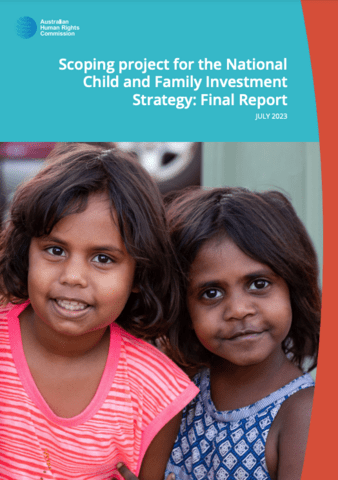
Scoping project for the National Child and Family Investment Strategy: final report
In this report, the National Children’s Commissioner makes 18 recommendations about how the National Child and Family Investment Strategy should work.
Evaluation
Evaluation of the Australian Human Rights Commission ‘IncludeAbility’ Project 2020-2023
The evaluation outlines the achievements of the IncludeAbility disability employment project, highlighting the success of its pilot programs and presenting key findings. The data reveals that overcoming persistent barriers to disability employment requires long-term, organisation-wide support beyond high-level inclusion policies, with coordinated strategies to assist both employers and employees concluding with strategic insights to guide...

Guide
Human Rights Impact Assessment Tool: AI-informed decision-making systems in banking
The Australian Human Rights Commission has partnered with the National Australia Bank (NAB) to develop and produce this human rights impact assessment tool for artificial intelligence-informed decision-making systems in banking (HRIA Tool).

Report
Safeguarding children: using a child rights impact assessment to improve our laws and policies
In 2022, the National Children’s Commissioner, in collaboration with UNICEF Australia, commenced a project to develop a Child Rights Impact Assessment (CRIA) tool for policy-makers and legislators. This report outlines the reasons for using CRIAs in policy and legislative development, and the process undertaken to develop the CRIA.