

Organisation
Organisation for Economic Co-operation and Development (OECD)
Website:
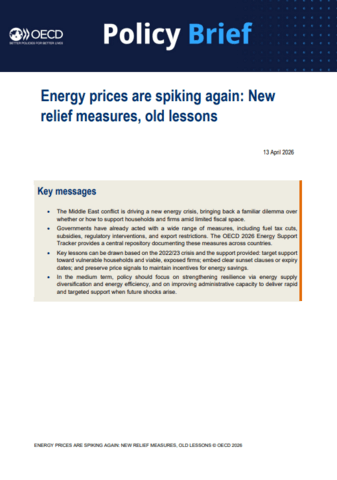
Briefing paper
Energy prices are spiking again: new relief measures, old lessons
This brief summarises the support measures governments have implemented in response to the sharp rise in energy prices linked to the Middle East conflict. Many OECD countries have moved quickly to provide support, most often through fuel-tax cuts and other price-support measures, while targeted income support and regulatory interventions have been used less widely.
Report
Measuring and monitoring gender wage gaps in public administrations
Gender pay gaps are a critical manifestation of gender inequalities in the labour market, reflecting a range of differential outcomes and factors facing men and women today. Gender pay gaps also help to predict gender inequalities tomorrow. This technical paper provides key recommendations for pay gap reporting for public administrations.

Report
Foundations for growth and competitiveness 2026
The report looks at structural reforms in policy areas that have been identified as priorities to lift growth in OECD and selected non-OECD countries. The selection of priorities is supported by a database of internationally comparable indicators that enable countries to assess their economic performance and structural policies in a wide range of areas.
Report
Mandatory spending in budgeting in selected OECD countries
Large portions of spending by national governments can be considered mandatory. Drawing on practices from eight OECD countries, this paper examines how governments define, monitor and review mandatory spending. The analysis suggests that mandatory spending should be reviewed regularly, included in fiscal rules and budget processes, and be subject to clear accountabilities to parliament.

Report
Scaling artificial intelligence in health
Artificial Intelligence (AI), when scaled responsibly, holds significant potential for healthcare systems. Yet significant barriers to its adoption remain, including fragmented data foundations, regulatory uncertainty, and gaps in governance and workforce capacity. To help support actions toward the responsible scale of AI in health, a policy checklist was developed to guide decision making and prioritisation.