

Organisation
Organisation for Economic Co-operation and Development (OECD)
Website:
Report
Policy responses to rising Autism diagnoses in childhood
Autism Spectrum Disorder (ASD) diagnoses among children and young people have risen two to fourfold across OECD countries, largely due to improved detection. While this increases demand for disability and health supports, it can improve outcomes. The report finds wide variation in supports and a shift towards basing entitlement for support on the needs of...
Report
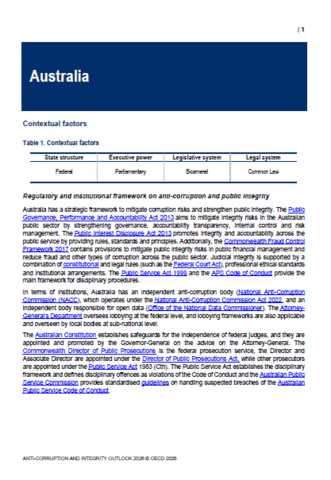
Anti-corruption and integrity outlook 2026: Australia
This country note on Australia outlines the regulatory and institutional frameworks on anti-corruption and public integrity. It provides contextual factors, and reports on lobbying, conflict of interest, political finance, access to public information, judicial integrity, prosecutorial integrity and disciplinary system for civil servants. It benchmarks Australia's performance against other OECD countries.
Guide
Migration anticipation and preparedness
Governments face increasing pressure to respond swiftly and effectively to rapidly evolving international migration flows. Anticipation is key to this response, but remains a challenge. This guide offers measures to introduce, run and strengthen migration forecasting systems and preparedness strategies. It follows the forecasting lifecycle from problem definition to communication and system learning.
Briefing paper
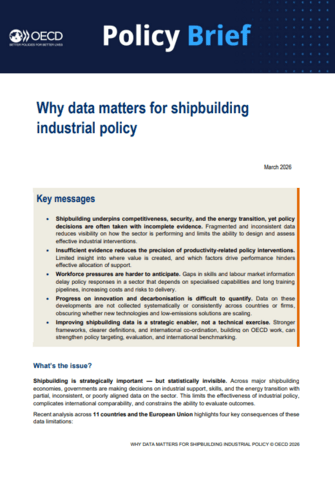
Why data matters for shipbuilding industrial policy
Shipbuilding is strategically important – but statistically invisible. Across major shipbuilding economies, governments are making decisions on industrial support, skills and the energy transition with partial, inconsistent or poorly aligned data on the sector. This policy brief presents analysis across 11 countries and the European Union highlighting four key consequences of these data limitations.
Report
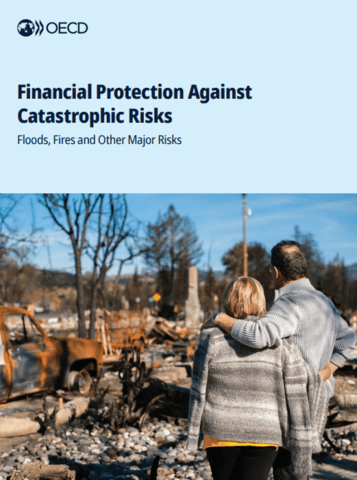
Financial protection against catastrophic risks
This report aims to help governments strengthen financial resilience against catastrophic risks. It provides a framework to assess the need for government-supported financial protection and the advantages and disadvantages of the main approaches to offering such support. It applies this framework to three types of large-scale risks: natural hazards, infectious disease outbreaks and cyber-attacks and...