

Working paper
Change in dental visits among eligible children under the impact of the Child Dental Benefits Schedule in Australia
In Australia, child oral health remains a significant population health problem. This study evaluated the impact of the Child Dental Benefits Schedule (CDBS) on dental visits among eligible children and adolescents in Australia. It showed that the CDBS policy had a statistically significant and positive impact on dental visits among eligible children and adolescents.
Working paper
Educational pathways and earnings trajectories of second-generation immigrants in Australia
The paper explores disparities in educational attainment and earnings trajectories among Australian-born children of diverse parental migration backgrounds from mid-adolescence to early adulthood. It highlights the importance of considering parental migration backgrounds in understanding post-school outcomes of Australian-born children. The paper finds that Non-English Speaking Background second-generation immigrants exhibit superior academic outcomes.
Working paper
Motels as crisis accommodation for families
In response to the current housing crisis, governments across the country are implementing strategies to facilitate access to crisis accommodation for people. Increasingly, this crisis accommodation is provided in the form of motels. This paper seeks to summarise current evidence relating specifically to at-risk families residing in motels, finding that it is a suboptimal model.
Submission
Submission to the Attorney-General Department consultation paper on ADM reform
This submission argues that a more comprehensive regulatory framework for automated decision-making (ADM) in the public sector is required. It calls for a framework that goes beyond existing administrative law, is not limited to AI-based systems and includes measures for prevention, enforcement and accountability.
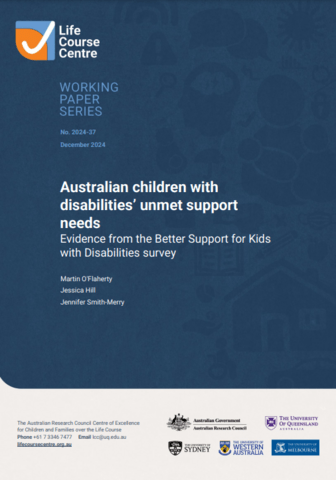
Working paper
Australian children with disabilities’ unmet support needs
This paper analyses survey collected data from parents or carers of children with disabilities (aged 2-17) on their use of services, experiences of disability support, and unmet needs for support. The findings indicate that there are substantial unmet needs for support among Australian children with disabilities and that these unmet needs are inequitably distributed.