

Housing development
Alternative labels
Housing planning
Report
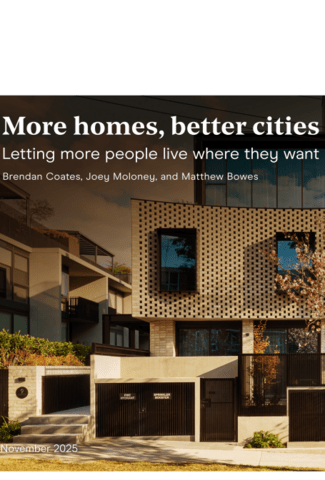
More homes, better cities: letting more people live where they want
This report finds that housing in Australia's major cities is among the least affordable in the world. It proposes that three-storey townhouses and apartments should be permitted on all residential land in all capital cities as part of a concerted policy assault on the housing crisis. The report provides 11 recommendations.
Report
No, councils don't approve 98% of permits for new housing
This analysis refutes the claim that Victorian local councils approve 98% of housing permits. Its findings show that metropolitan Melbourne councils approve on average less than three-quarters of permits for new dwellings. The analysis confirms that council planning processes and decisions are a significant bottleneck in housing delivery. It proposes that consistent, metropolitan-wide planning rules...

Report
Community consultation is unrepresentative and biased
An analysis of 17 community consultation demographics across seven metropolitan local councils in Melbourne, Victoria. This research note tests a simple hypothesis: that Victorian local council consultations are biased toward older homeowners. It finds that the community consultation models tend to favour the time-rich (property owners and older residents) over the time-poor (renters and younger...

Report
Improving housing outcomes for Australians: National Housing Infrastructure Facility
This review of the National Housing Infrastructure Facility (NHIF) provides an in-depth look at the performance, evolving impact and the housing outcomes achieved through NHIF-funded projects to 31 December 2024. Since the NHIF mandate expanded in 2022 to include social and affordable housing, more than $340 million has been directed to such projects.
Report
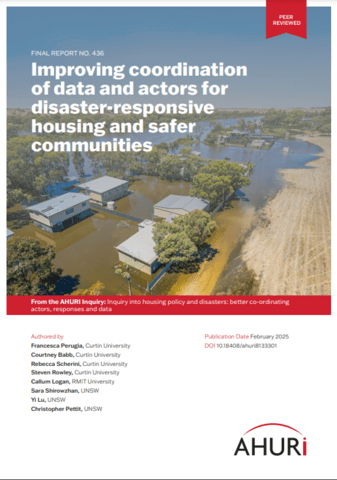
Improving coordination of data and actors for disaster-responsive housing and safer communities
This research examines how governments and organisations involved in planning and delivering housing use data to assess risks associated with flooding, bushfires and cyclones. It explores ways to use and share data better in order to reduce the impact of disasters.