

Report
 SHARE
SHARE
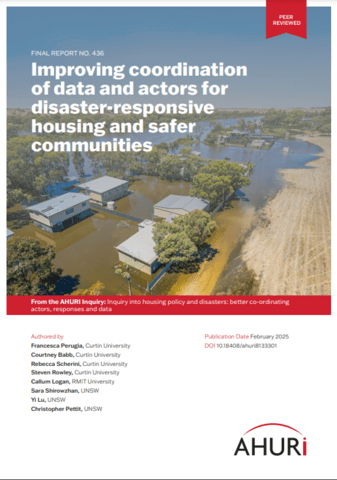
Improving coordination of data and actors for disaster-responsive housing and safer communities
Yi Lu, Christopher Pettit
Publisher
Housing development
Urban planning
Risk assessment
Data availability
Climate risk
Disaster planning
Disaster resilience
Data access
Australia
New South Wales
Victoria
Western Australia
Resources
| Attachment | Size |
|---|---|
 Improving coordination of data and actors for disaster-responsive housing and safer communities Improving coordination of data and actors for disaster-responsive housing and safer communities
|
7.94 MB |
Description
Having access to quality data plays a crucial tool in managing and mitigating natural hazard risks. It enables authorities to make efficient and informed decisions regarding what land is used for housing and development. Good data is essential to inform strategies for reducing risks and enhancing preparedness for disasters. It can also improve coordination of disaster response and post-disaster recovery activities.
This research Nexamines how key actors involved in the housing planning and delivery process in New South Wales, Victoria and Western Australia use data to assess disaster risk associated with flooding, bushfires and cyclones. It explores ways to use and share data better in order to reduce the impact of disasters.
Key points
- Assuming a users’ perspective, the research discusses how data could be better used and shared for the planning and delivery of new housing to reduce the impact of disaster events.
- Australia has a complex data landscape. It is unorganised and characterised by data fragmentation and duplication.
- Flood hazard data are the most inconsistent data in terms of accuracy, data coverage, accessibility and availability.
- While overall data availability and accessibility have improved over time, access to spatialised data identifying potential and actual impacts associated with natural disasters is lagging behind.
- Key actors involved in housing planning and delivery identified state and local government policies as playing an essential role in disaster risk assessment, second only to hazard data.
- Planning processes are not agile enough to keep up with the fast pace of information and available data
Publication Details
Peer Reviewed:
Yes
DOI:
10.18408/ahuri8133301
ISBN:
978-1-923325-05-0
Copyright:
Australian Housing and Urban Research Institute Limited 2025
License type:
CC BY-NC
Access Rights Type:
open
Series:
AHURI Final Report No. 436
Post date:
19 Feb 2025
