

Policy analysis
Alternative labels
Policy advice
Report
Why we should not increase capital gains tax
This paper examines the economic case for the capital gains tax (CGT) discount and concludes that many of the arguments for reducing it are based on persistent myths rather than evidence. The paper argues that housing should not dominate the CGT debate. It finds that some form of concessional treatment for capital gains is economically...
Briefing paper
Why data matters for shipbuilding industrial policy
Shipbuilding is strategically important – but statistically invisible. Across major shipbuilding economies, governments are making decisions on industrial support, skills and the energy transition with partial, inconsistent or poorly aligned data on the sector. This policy brief presents analysis across 11 countries and the European Union highlighting four key consequences of these data limitations.
Report
Suicide prevention policy development and monitoring
Suicide is the leading cause of death for Australians aged 15 to 44 years. From 2022–23 to 2025–26, the Department of Health, Disability and Ageing administered 41 suicide prevention measures. This report finds that four to five years after several national agreements, objectives to reduce suicide have not been achieved.
Briefing paper
Responses to antisemitism and Islamophobia
The report provides a summary of civil laws, criminal laws, reviews or reforms currently in progress, and best practice initiatives in response to antisemitism and Islamophobia in Australia – presenting anti-vilification measures for each state and territory government and the Commonwealth.
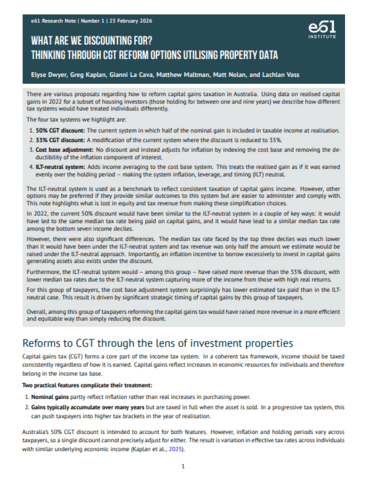
Briefing paper
What are we discounting for? Thinking through CGT reform options utilising property data
There are various proposals regarding how to reform capital gains taxation in Australia. Using data on realised capital gains in 2022 for a subset of housing investors (those holding for between one and nine years) this paper describes how four different tax systems, including the current system, would have treated individuals differently.