

Policy analysis
Alternative labels
Policy advice

Report
The economic case for preventing mental ill health
Poor mental health affects more than one in five people across OECD and European Union countries. Focusing on depression and anxiety, this report sets out the strong economic case for investing in better mental health policies. It shows how evidence‑based interventions can improve health outcomes and boost economic growth through improved productivity and labour market...

Report
International students in higher education
Australia, Canada, France, Germany, the Netherlands and the United Kingdom have been among the OECD countries with the strongest growth in international student enrolment over the last decade. This report examines the journey and challenges of international students. By comparing six major OECD study destinations, the report highlights both shared challenges and emerging policy responses.

Discussion paper
Artificial intelligence and evidence-informed policy – emerging challenges and opportunities: discussion paper
This discussion paper examines the intersection of artificial intelligence (AI) and evidence-informed policymaking, outlining how AI can support problem identification, policy design and implementation. It emphasises that AI augments rather than replaces human judgement, while highlighting its potential to expand the evidence base and support more timely, responsive decision-making in complex health contexts.
Report
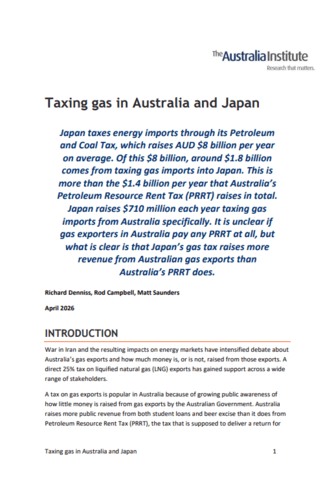
Taxing gas in Australia and Japan
War in Iran and the resulting impacts on energy markets have intensified debate about Australia’s gas exports. While Australian debate on taxation of gas features regular international comparisons, a comparison with Japan itself is rarely made. This report aims to fill this gap with a basic introduction to Japan’s Petroleum and Coal Tax.
Report
Acceleration is not a strategy: a framework for directing AI towards public value before it's too late
The politics of artificial intelligence (AI) is set to drastically change in 2026 as recent technical breakthroughs are implemented across the economy. This report draws reflections from work on AI policy and highlights next steps, with recommendations for governments seeking to demonstrate that they are intervening ambitiously in their citizens’ interests.