

Assistance animals
Alternative labels
Guide dogs
Animals (therapeutic use)
Service animals
Support animals
Assistance animal
Discussion paper
National principles for the regulation of assistance animals: consultation paper
Assistance animals are trained to support the independence and wellbeing of people with disability. This paper invites feedback on draft national principles for the regulation of assistance animals in the interests of clarity and national consistency.
Journal article
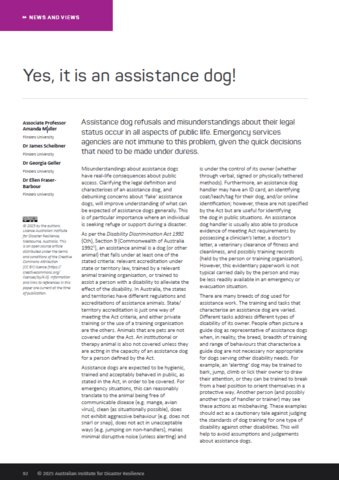
Yes, it is an assistance dog!
The article explains that misunderstandings about assistance dogs, including legal definitions and accreditation, frequently lead to access refusals, even during emergencies. It clarifies obligations under the Disability Discrimination Act 1992, outlines expected behaviour and training standards, and urges emergency services to improve awareness so people with disability can safely access refuge, evacuation and support during...
Report
Investigating the benefits of assistance dogs or pet dogs for people with autism
The NDIA’s Research and Evaluation Branch has completed a comprehensive systematic review and meta-analysis of quantitative studies, and meta-aggregation of qualitative studies to understand the benefits of assistance dogs or pets for people with autism.
Evaluation
Evaluation of the Trial of Assistance Dogs as an Adjunct to Therapy for Veterans with Posttraumatic Stress Disorder (PTSD)
An evaluation of a research trial of the psychiatric assistance dogs for veterans with PTSD. The Trial evaluated the life experiences of veterans through their journey of being paired with a specifically trained assistance dog. A mixed methods approach was used and participants included 17 veterans, their support persons and stakeholders participating in the Trial...

Report
Housing and housing assistance pathways with companion animals: risks, costs, benefits and opportunities
This study investigates the policy and regulatory settings that shape housing options available to households that own companion animals. It considers housing and housing assistance contexts nationally across tenures, sectors, emergency/crisis accommodation, and for diverse population groups receiving income and housing assistance support.