

Public sector innovation
Report
Trust Imperative 5.0: building trust in government through practical AI assurance
Governments have moved rapidly from experimenting with artificial intelligence (AI) to deploying it. But a gap has emerged between governments’ ambition to scale AI and their ability to deploy systems with confidence. This report finds that most governments have established AI ethics principles, governance models or national frameworks. The challenge lies in day-to-day execution.
Case study
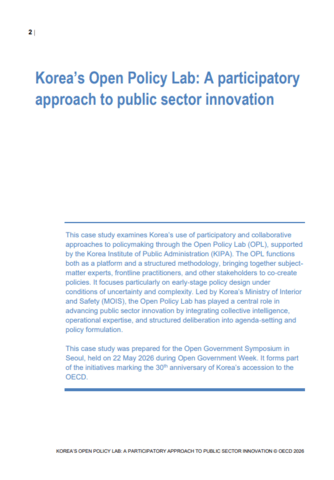
Korea’s Open Policy Lab: a participatory approach to public sector innovation
This case study examines Korea’s use of participatory and collaborative approaches to policymaking through the Open Policy Lab (OPL). The OPL functions both as a platform and a structured methodology, bringing together subject-matter experts, frontline practitioners and other stakeholders to co‑create policies. It focuses particularly on early‑stage policy design under conditions of uncertainty and complexity.
Guide
The GovTech compass: ten principles for the responsible implementation of GovTech and digital public infrastructure
Digital transformation offers governments a powerful pathway to improve public service delivery and strengthen state capability. Yet without clear guardrails, these efforts can deepen exclusion, weaken accountability and produce systems that fail to reflect the lived realities of citizens. This guide offers a principles-based framework for more responsible and effective digital transformation.

Report
Approved: how AI and data can transform Australia’s environmental approvals
Approximately $278 billion in construction work across housing and clean energy is relying on Australia’s environmental approvals system – but growing complexity, workforce shortages and outdated systems are putting delivery at risk. According to this report, artificial intelligence (AI) can help unlock the pipeline. It identifies what’s possible, what’s emerging and what to do about...
Report
Stack thinking: options for reshaping the DNA of governments
This report explores the concept of stack thinking, which reframes how complex systems can be organised. Instead of organising around departments, systems are organised around functions and layers. Applied to government, stack thinking suggests a different model of institutional design.