

Government integrity
Report
From box-ticking to trust-building: enhancing integrity in public consultation
Too often, government consultation is treated as a box-ticking exercise – yet it sits at the heart of legitimacy, accountability and public trust. This paper shows how public consultation integrity can deliver better decisions and reduce the disproportionate influence of vested interests, but only when consultation is genuine, accessible and done early – before outcomes...
Report
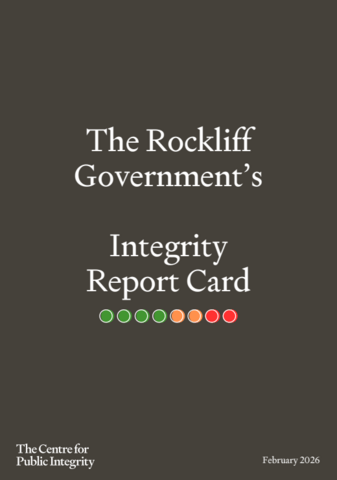
The Rockliff Government’s integrity report card
The integrity scorecard assesses the first six months of the re-elected Rockliff Government (Tasmanian Government) across eight reform areas, including Right to Information, ministerial diary disclosure, lobbying oversight, integrity in appointments, parliamentary standards, government advertising, the Government’s relationship with integrity officers and reforms to the Integrity Commission. It finds an uneven integrity performance.
Position paper
Law-making with integrity: enhancing the quality of laws and public trust in law-making
A well-functioning democracy depends on informed, transparent and accountable law-making. Using recent case studies, this paper shows how limited consultation and attempts to short-circuit committee scrutiny can undermine legislative quality and democratic legitimacy. The paper calls for four law-making integrity safeguards to be embedded as standard practice as a practical standard for the Australian Parliament.
Report
No favourites: report of the review into public sector board appointments processes
This review considers and proposes appropriate standards for the processes by which board members are appointed to Australian Government boards. It finds the current board appointment arrangements are not fit for purpose and proposes a series of reforms to the processes by which board members are identified, selected, appointed and supported in their roles.
Report
APS reform: annual progress report 2025
The Australian Public Service (APS) reform program has built on previous reform efforts and is now in its third and final phase. This report outlines the key achievements under the four pillars of the program. 54 of 59 initiatives are either complete or in delivery, with agencies across the APS actively adopting and embedding changes.