

Intellectual and developmental disability
Alternative labels
Learning disability
Intellectual disability
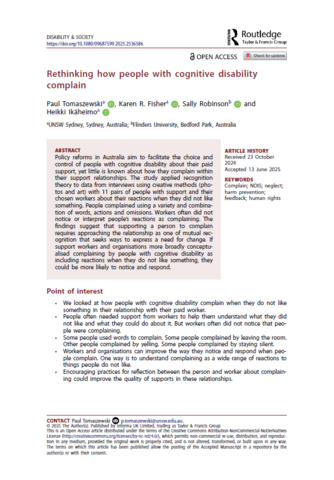
Journal article
Rethinking how people with cognitive disability complain
People with cognitive disability express dissatisfaction in varied ways, often missed by support workers. This study shows complaints can be verbal, behavioural or silent, and effective support relies on mutual recognition and broader understandings of “complaining.” Improving awareness and responses is essential, and further research is needed to understand what helps or hinders people and...

Submission
Supported employment: submission to the Department of Social Services
A submission by Inclusion Australia in response to the Department of Social Services’ (DSS) discussion paper: Next Steps in Supported Employment. The submission directly addresses all seven consultation questions posed in the discussion paper and it also raises broader systemic issues that extend beyond the immediate scope of supported employment services. The submission provides 29...
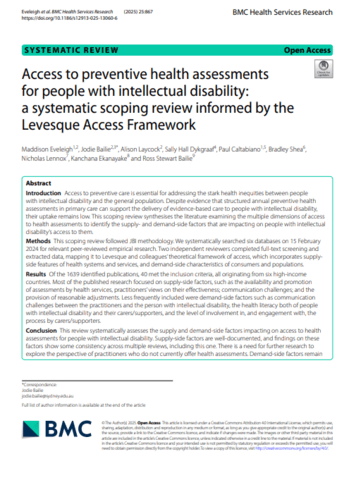
Journal article
Access to preventive health assessments for people with intellectual disability
This scoping review examines the multiple dimensions of access to health assessments; identifying the supply- and demand-side factors that impact access for people with intellectual disability. It concludes that supply-side factors are well-documented, while demand-side factors warrant further investigation and research.
Guide
Sex education for students with intellectual disability and on the autism spectrum
A comprehensive resource designed to support effective sex education delivery. The guide incorporates evidence-based practices specifically developed for students with intellectual disability and on the autism spectrum. It features ready-to-use lesson plans covering essential topics from relationships and consent to sexual health and personal safety.

Guide
Supporting problem solving, concentration and memory at work
This guide explains how employers can support employees with cognitive conditions that affect problem solving, concentration and memory. It outlines practical, low‑cost workplace adjustments such as reducing distractions, using reminders, checklists and visual tools, and encouraging creative thinking to help employees work more confidently, reduce stress, and perform effectively in inclusive workplaces.