

Internal migration
Report
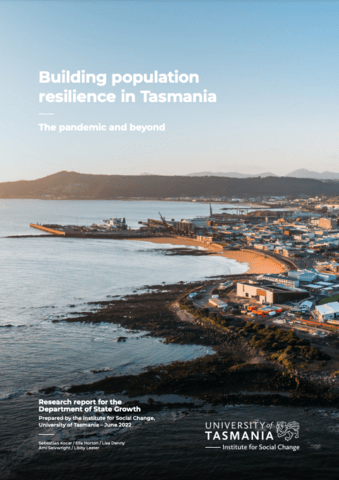
Building population resilience in Tasmania: the pandemic and beyond
As the size, composition and geographic distribution of the Tasmanian population is impacted by COVID-19, the Tasmanian Department of State Growth commissioned this research to inform its update of Tasmania’s Population Strategy.

Briefing paper
Visualising the population impacts of COVID-19 in Victoria
One of the biggest impacts of the COVID-19 crisis so far has been a sudden reduction in Victoria's population. This paper explores the implications of the crisis in an historical perspective. It provides estimates of the impacts on different electorates and develops a cluster analysis of different areas in the state.

Report
The great migration: leaving our cities for the regions - part 2: current working patterns, future work perspectives
COVID-19 has forced us to reimagine the way we’re working now and into the future. This second instalment in the Future of Work Lab’s 'Regional Migration Survey' series, aims to better understand the current working patterns and future work aspirations of people who have migrated to regional Victoria from metropolitan areas across Australia.

Report
The great migration: leaving our cities for the regions - part 1: internal migration patterns, motivations and experiences
The internal migration of Australians from metro to regional areas has received increasing attention since the beginning of the COVID-19 pandemic. This first instalment of the Future of Work Lab’s 'Regional Migration Survey' aims to better understand the migration patterns, motivations and experiences of internal migrants.
Working paper
The laws of attraction: economic drivers of inter-regional migration, housing costs and the role of policies
The capacity of workers to move regions in response to local economic shocks is one key dimension of labour market dynamism which could contribute to the recovery from the COVID-19 crisis. In this context, this paper proposes articulating structural with place-based policies to help prospective movers as well as stayers.