

Managing to outcomes
Article
Bringing relational contracting to life
This article draws on Social Ventures Australia's experience with the Resolve Social Benefit Bond (Resolve SBB), which funded a psychosocial, recovery-oriented community support program. It reviews the features of relational contracting and provides insights from this experience for commissioners to understand what relational contracting looks like when taken from concept to delivery.
Strategy
National suicide prevention outcomes framework
The framework provides a way of measuring the impact of efforts being made in suicide prevention in Australia. This overview provides a description of the framework, its components and how they operate together. The framework comprises four components: an overview, an outcomes map, data quality and improvement plan and a monitoring and reporting plan.
Article
The ‘whys’ of measuring outcomes for grant makers
Government departments across Australia have started integrated reporting on outcomes into their funding agreements, as have many philanthropic funders. Yet, for funders, being intentional about the purpose and method of measurement is important. The article identifies five common reasons. For each, the article describes what they are and the implications for how outcomes are measured.

Working paper
Long-term, national strategy: designing a contemporary practice of national strategy
This paper sets out to examine how governments come to a national view of what really matters over longer time horizons, the ways governments can best confront and tackle future problems, and how the configuration, mechanisms and capabilities of the state can best enable the pursuit and delivery of long-term outcomes for citizens.
Journal article
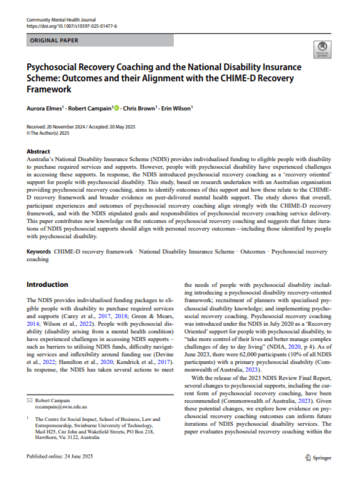
Psychosocial recovery coaching and the National Disability Insurance Scheme
Australia’s National Disability Insurance Scheme (NDIS) introduced psychosocial recovery coaching as a ‘recovery oriented’ support for people with psychosocial disability in responsiveness to challenges in accessing these supports. This paper examines the outcomes of psychosocial recovery coaching and suggests future iterations of NDIS psychosocial supports should align with personal recovery outcomes.