

Evaluation
 SHARE
SHARE
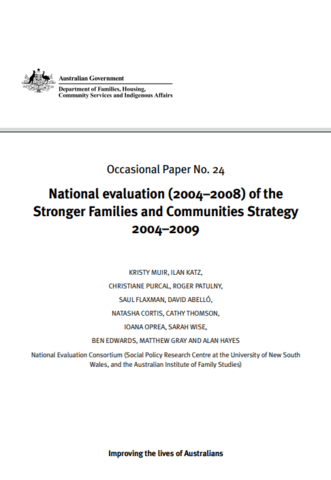
National evaluation (2004-2008) of the Stronger Families and Communities Strategy 2004-2009
Publisher
Service integration
Outcome evaluation
Process evaluation
Early childhood development
Communities
Family services
Community-based family services
First Peoples families
Australia
Resources
| Attachment | Size |
|---|---|
 National evaluation (2004-2008) of the Stronger Families and Communities Strategy 2004-2009 National evaluation (2004-2008) of the Stronger Families and Communities Strategy 2004-2009
|
672.5 KB |
Description
This national evaluation covers three of the Stronger Families and Communities Strategy (SFCS) initiatives: Communities for Children (CfC), Invest to Grow and Local Answers. The SFCS aimed to:
- help families and communities build better futures for children
- build family and community capacity
- support relationships between families and the communities they live in
- improve the ability of communities to help themselves.
The evaluation examines service provision, service coordination, Indigenous families and children in CfC sites, factors that facilitate or hinder service provision and outcomes, and sustainability.
The methodology was designed to address the SFCS outcomes framework and the findings are based on a range of sources and methodologies. These include:
- the Stronger Families in Australia (SFIA) study: a three-year longitudinal survey of 2,202 families with children aged 2 to 5 years in 10 CfC communities and five non-CfC, ‘contrast’ communities
- an outcome indicators framework: analysis of secondary data for evidence of community-level changes
- service mapping in all 45 CfC sites in 2006 and 2007
- a service coordination study
- a partnership model study
- the analysis of progress reports
- three themed studies on engaging fathers, and Indigenous and hard-to-reach families.
Key findings
- Many research participants compared the SFCS 2004–2009 model favourably with other funding models noting that it gave service providers considerable control over the types of services they could provide and the way they could deliver them.
- Programs benefited greatly from consultations and partnerships with Indigenous organisations and community members, but effective community engagement takes considerable time, especially in rural and remote areas.
- Partnerships, better coordinated services, and a focus on early childhood may be long-term outcomes of the SFCS 2004–2009 initiative in some areas. However, without ongoing funding, it is unlikely that SFCS 2004–2009 programs will be sustainable. Short-term interventions can fuel resentment and mistrust.
Publication Details
ISBN:
978-1-921380-44-0
Copyright:
Commonwealth of Australia 2009
Access Rights Type:
open
Series:
Occasional Paper No. 24
Post date:
24 Jun 2009
