

 SHARE
SHARE
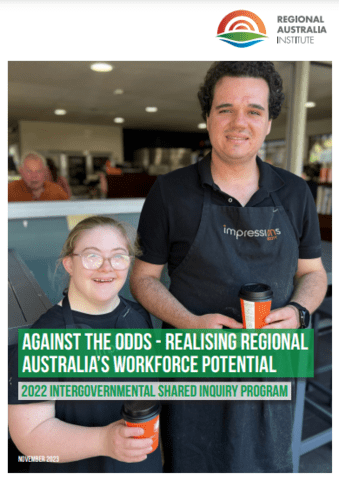
Against the odds: realising regional Australia’s workforce potential
| Attachment | Size |
|---|---|
 Against the odds: realising regional Australia’s workforce potential Against the odds: realising regional Australia’s workforce potential
|
35.05 MB |
In the context of tight labour markets and persistent job vacancies, regional labour market systems are in the spotlight. Governments, businesses, educational institutions and social organisations are looking for actionable strategies to connect workers with work.
However, while tight labour markets have emerged recently in Australia’s capital cities, regional Australia has been challenged by increasing workforce shortages for some time. Regional labour market systems are demonstrating extraordinary innovation, high levels of collaboration and creative approaches to resource management. At the same time, despite common views to the contrary, there are many places in regional Australia with higher labour force participation rates than exist in capital cities.
This report identifies strategies being used by government, business, education and community organisations in regional Australia to build skills in the regions, address workforce shortages and overcome structural barriers to participation.
Regional Australia supports a range of highly effective regional employment ecosystems that are delivering results in local efforts to connect workers with work. However, there are many broken links, that, if resolved, promise to facilitate stronger regional economies. Policy interventions across all levels of government and the different spheres of the employment ecosystem offer opportunities to strengthen local activities. Preliminary policy principles and recommendations to support these goals include:
- Tailored, place-based approaches are needed to address local circumstances.
- Integrated employment and social policy approaches are needed to facilitate coordinated economic and social outcomes.
- Education funding models need to deliver flexible, place-based approaches and increase integration between training and employment.
- Whole of region structural transformation funding is required to support effective future planning, including for workforce.
- Support for small business is needed to facilitate improved accessibility and awareness of diverse group needs.
