

Report
 SHARE
SHARE
Integrating housing policy, settlement planning and disaster management
Publisher
Housing
Housing assistance
Planning
Emergency services
Disaster planning
Disaster resilience
Disaster relief
Australia
Resources
| Attachment | Size |
|---|---|
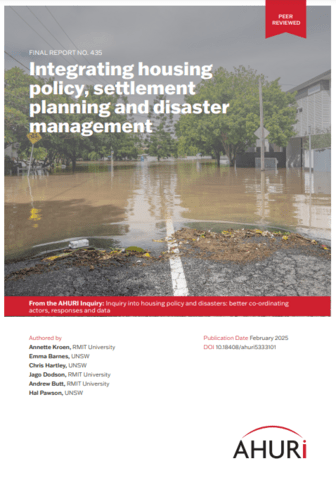
 Integrating housing policy, settlement planning and disaster management Integrating housing policy, settlement planning and disaster management
|
2.4 MB |
Description
Australia faces many natural hazards like bushfires, floods, storms and cyclones. Climate change is making these events more frequent and intense. Because housing is heavily impacted during disasters, it's crucial that housing policy works closely with disaster risk reduction and response.
This research looks at how housing policy and planning can better prepare for natural disasters, and enable recovery from them. It examines institutional arrangements, planning coordination and disaster management responses.
Key points
- Integrating housing policy, settlement planning and disaster management is crucial. Disasters caused by natural hazards typically have major impacts on housing, while settlement planning can influence exposure to disasters and the scale of their impact.
- Coordinating and integrating housing, planning and disaster management in Australia has improved in the last decade, but further standardisation and development is required.
- Relevant Australian agencies are improving their approaches to housing related disaster management, but there needs to be greater priority given to disaster risk reduction in housing policy. Disaster risk reduction and preparedness are being increasingly considered in land use planning, though tensions can arise with economic and development goals.
- Planning and housing decisions must be supported by clear appreciation of disaster risks. Relevant government agencies need to improve data sharing, harmonise data use and communicate more effectively with the public about risks identified through data analysis.
- While recovery processes need to respond to each specific disaster situation, developing standards in advance of a disaster would accelerate recovery. This may include creating lists of suitable and available temporary housing types.
- Local governments often require additional resources to be able to respond appropriately to housing and planning requirements in the recovery phase.
- Including local communities in disaster preparedness and response helps shape recovery approaches that meet the needs of impacted communities. This includes making disaster risk data publicly available. Community engagement also improves understanding and acceptance of risk reduction measures.
Publication Details
Peer Reviewed:
Yes
DOI:
10.18408/ahuri5333101
ISBN:
978-1-923325-06-7
Copyright:
Australian Housing and Urban Research Institute Limited 2025
License type:
CC BY-NC
Access Rights Type:
open
Series:
AHURI Final Report No. 435
Post date:
19 Feb 2025
