

Report
 SHARE
SHARE
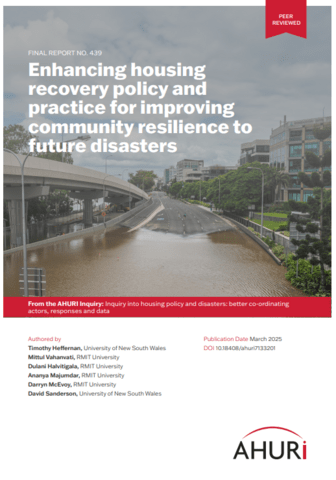
Enhancing housing recovery policy and practice for improving community resilience to future disasters
Ananya Majumdar, Darryn McEvoy, David Sanderson
Publisher
Building codes
Sustainable building
Housing
Planning
Zoning
Disaster planning
Disaster resilience
Community recovery
Australia
Resources

Description
The threat to housing in Australia from hazards such as bushfires, floods and cyclones is increasing, with replacement costs escalating. With one in 25 Australian homes (around 500,000 homes) reportedly at high risk of becoming effectively uninsurable by 2030, new short-term relief strategies and longer-term housing recovery solutions need to be developed.
This report explores the housing policies that can improve community preparedness and responses to disasters.
Key points
- Post-disaster housing recovery is slow, frustrating and complex, with challenges set to increase.
- The best approach is prevention: enacting land use planning and zoning so construction avoids hazard-prone locations.
- Local accommodation options, such as parks, motels and hotels, utilise existing infrastructure and support local economies.
- Temporary housing villages are costly, take time to build and delay problem solving, and create new problems.
- Local Government Areas with adequate resources should play a central role in community mitigation and preparedness planning.
- Buybacks and planned relocation present a positive mitigation approach but are complex, can take time, and can be divisive.
- Home insurance premiums are becoming unaffordable, thereby decreasing people’s ability to recover.
- Build back better approaches need to become the norm in rebuilding.
Publication Details
Peer Reviewed:
Yes
DOI:
10.18408/ahuri7133201
ISBN:
978-1-923325-08-1
Copyright:
Australian Housing and Urban Research Institute Limited 2025
License type:
CC BY-NC
Access Rights Type:
open
Series:
AHURI Final Report No. 439
Post date:
3 Apr 2025
