

First Peoples
Aboriginal and Torres Strait Islander peoples should be aware that this resource may contain images or names of people who have since passed away.
 SHARE
SHARE
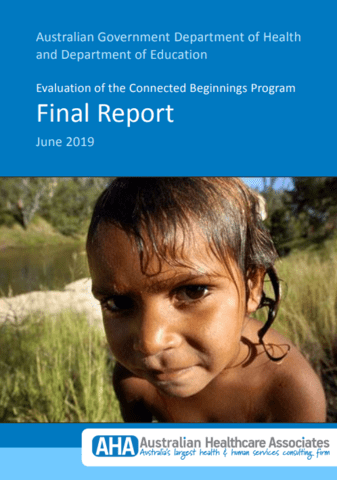
Evaluation of Connected Beginnings program: final report

The Connected Beginnings program (CB) is aimed at integrating early childhood, maternal and child health and family support services with schools in disadvantaged Indigenous communities to prepare children for school.
This evaluation seeks to assess program effectiveness, identify key learnings for wider rollout and characterise successful sites. The evaluation examined 14 sites progressively selected over three years, with 25 organisations contracted (13 Education-funded, 12 Health-funded). The evaluation aimed to dentify:
- the factors that contributed to the Program’s success
- which communities obtained the greatest benefit, in terms of education and health outcomes
- the capability and maturity of the service system within which the Program operates.
In consultation with the Departments of Health and Education over the two-year evaluation period, the evaluation methods were adapted in response to early evaluation findings and the evolution of the Program.
The evaluation demonstrated that CB can effectively support service integration across health, education and family support systems, though progress varies by site. Three defining features emerged: community-driven flexible approaches, connections to wider service systems and dual Education-Health funding at most sites. Early implementation revealed sites needed more guidance on service integration tasks, leading to adoption of Collective Impact approaches.
The evaluation concluded that while CB shows promise for service integration, longer implementation timeframes and enhanced guidance are essential for achieving meaningful outcomes in complex indigenous communities.
Key recommendations
- Strengthen program guidelines to emphasise community-driven approaches with Collective Impact/place-based initiative guidance and core funding for training.
- Extend funding timeframes beyond three years to support sustainable integration models.
- Develop unified Education-Health operational guidelines reflecting integration goals.
- Implement staged site selection with seed funding for community consultations.
- Clarify case management responsibilities and jurisdictional government roles.
- Build regular forums for sharing learnings between sites.
- Develop strategies to engage hard-to-reach communities through innovative outreach approaches.
