

Working paper
 SHARE
SHARE
What local land use reform does, and doesn’t, do
Publisher
Housing development
Infill development
Urban planning
Zoning
Land use
Policy analysis
Adelaide

Description
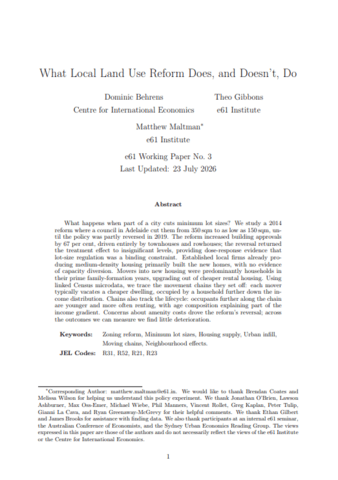
What happens when part of a city cuts minimum lot sizes? This paper studied a 2014 reform where a council in Adelaide cut them from 350 sqm to as low as 150 sqm, until the policy was partly reversed in 2019. The reform increased building approvals by 67%, driven entirely by townhouses and rowhouses; the reversal returned the treatment effect to insignificant levels, providing dose-response evidence that lot-size regulation was a binding constraint.
Key findings
- Established local firms already producing medium-density housing primarily built the new homes, with no evidence of capacity diversion.
- Movers into new housing were predominantly households in their prime family-formation years, upgrading out of cheaper rental housing.
- Using linked Census microdata, the movement chains they set off are traced: each mover vacates a cheaper dwelling, occupied by a household further down the income distribution.
- Chains also track the lifecycle: occupants further along the chain are younger and more often renting.
- Concerns about amenity costs drove the reform’s reversal; across the outcomes measured little deterioration was found.
Publication Details
Copyright:
e61 Institute 2026. Reproduced with permission.
License type:
All Rights Reserved
Access Rights Type:
open
Post date:
23 Jul 2026
