

Assistive technology
Journal article
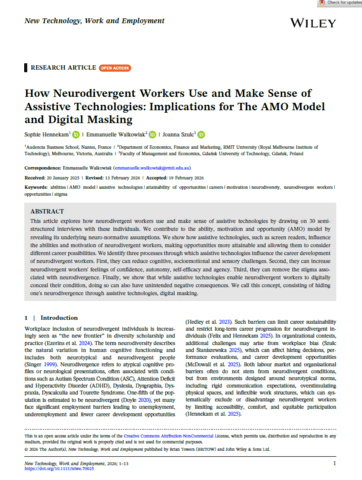
How neurodivergent workers use and make sense of assistive technologies
Assistive technologies reshape how neurodivergent workers experience ability, motivation, and opportunity. Tools like screen readers reduce cognitive, sensory and socioemotional challenges, boost confidence, autonomy and agency, and lessen stigma. They also enable digital masking – concealing neurodivergence – which can expand opportunities but may create unintended negative consequences.

Report
AI to support neurodivergent learners in vocational education and training
Artificial Intelligence (AI) and other advanced technologies could support neurodivergent learners in vocational education and training settings, including in work-based learning and apprenticeships, and the transition to work. This report explores the use of these technologies by learners with Autism Spectrum Disorder, Attention-Deficit/Hyperactivity Disorder, dyslexia, dyscalculia and dysgraphia, and by teachers and trainers catering for...
Journal article
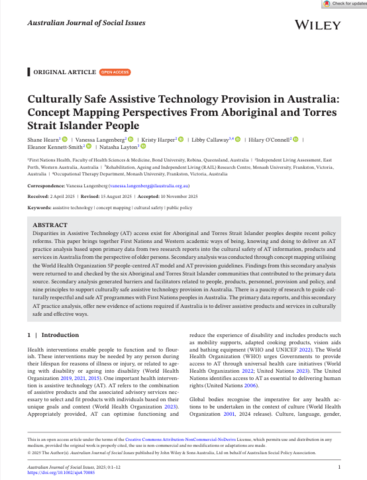
Culturally safe assistive technology provision in Australia
This study explores inequities in Assistive Technology (AT) access for Aboriginal and Torres Strait Islander peoples. Secondary analysis identified barriers and facilitators across people, products, personnel, provision and policy, generating nine principles for culturally safe AT delivery. The findings highlight actions needed for respectful and effective AT programs.
Journal article
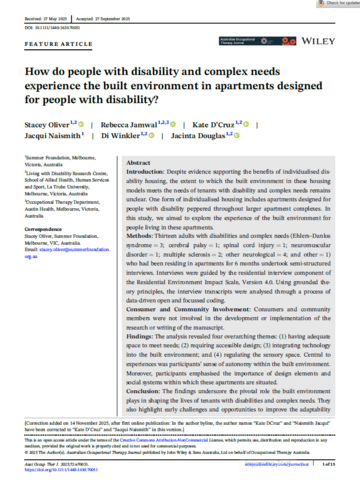
How do people with disability and complex needs experience the built environment in apartments designed for people with disability?
This study examines how apartments designed for people with disability and complex needs support daily life. It identifies four key design factors – space, accessibility, usable technology and sensory management – and finds that good design strengthens independence. Residents also emphasise the need for clearer pre‑move information, better integrated technology and strong support to help...

Report
The National Aged Care Advocacy Program presenting issues: report 5
This report provides a detailed analysis of the 52,206 instances of information and advocacy support provided to older people, their families and other supporters – an 18% increase on the previous year. Poor communication, lack of information and support to make decisions were reported to be the key challenges for the fifth year in a...