

Demographics
Report
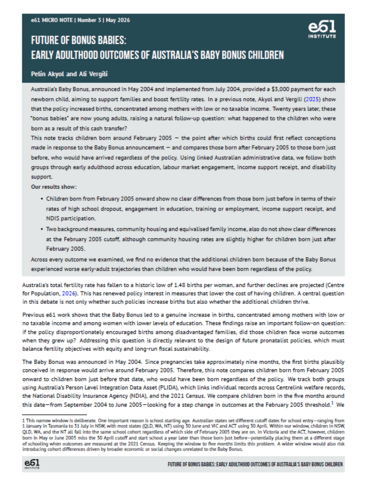
Future of bonus babies: early adulthood outcomes of Australia’s Baby Bonus children
Australia’s Baby Bonus, implemented from July 2004, provided a $3,000 payment for each newborn child, aiming to support families and boost fertility rates. Twenty years later, this paper explores whether the Baby Bonus shifted the course of these young people’s lives in a measurable way.
Report
Snapshot of children and young people with disability in Australia
This report provides a comprehensive national overview of children and young people with disability in Australia aged 0–25. It draws on publicly available data to bring together evidence on demographics, early childhood, education, employment, health and wellbeing, housing and transport, income and finance, NDIS supports, safety and justice, and social and community participation nationwide contexts.

Report
The way in: representation in the 48th Australian Parliament
This report examines representation in Australia’s 48th Federal Parliament and analyses gender, Indigeneity, cultural background, education, age and employment. It provides a statistical snapshot of members at the opening of the 48th Parliament, outlines pathways into politics, and highlights where parliamentary composition reflects or diverges from broader society.
Report
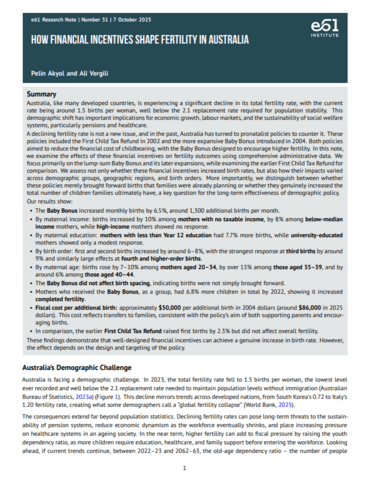
How financial incentives shape fertility in Australia
Australia, like many developed countries, is experiencing a significant decline in its total fertility rate. The First Child Tax Refund and the Baby Bonus policies aimed to reduce the financial cost of childbearing, with the Baby Bonus designed to encourage higher fertility. This note examines the effects of these financial incentives on fertility outcomes.
Briefing paper
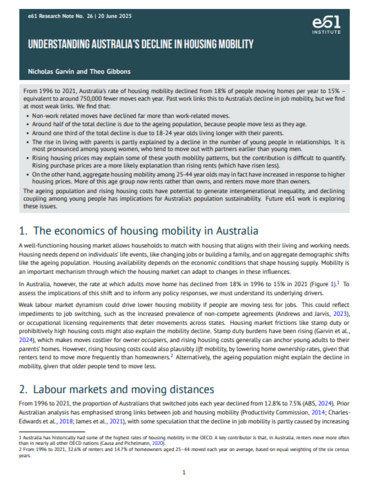
Understanding Australia's decline in housing mobility
From 1996 to 2021, Australia’s rate of housing mobility declined from 18% to 15%. This paper assesses the implications of this shift and outlines the underlying drivers. Past work links this to Australia’s decline in job mobility, but this paper finds at most weak links. The findings challenge a number of common narratives.