

Guide
 SHARE
SHARE
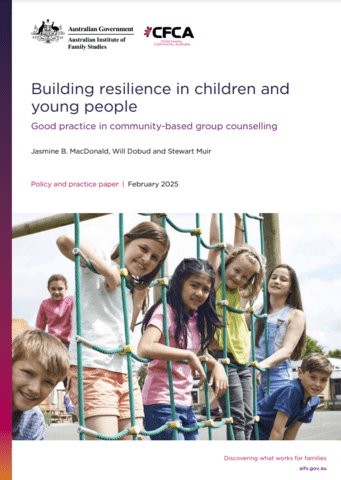
Building resilience in children and young people
Good practice in community-based group counselling
Publisher
Resilience (Personality)
Counselling
Youth
Children
Child mental health
Australia

Description
This paper describes what good practice looks like in community-based group counselling for building resilience in children and young people aged 7–20 years. It defines resilience as a dynamic process that draws on both personal and external resources, and outlines how counselling interventions aim to strengthen these personal and external resources.
It details three types of effective community-based group counselling interventions: psychoeducation, relaxation and mindfulness, and counselling with art.
The paper also provides a comprehensive table of personal, family, community and cultural resources that contribute to resilience.
Key messages
- Engagement can be enhanced by:
- running an intervention or program for a longer period and with more than one session a week
- increasing opportunities for clients to interact with counsellors and peers
- providing digital resources and other activities (such as physical activities) alongside the counselling.
- Counsellors and program coordinators can enhance the effectiveness of counselling interventions by focusing on the counsellor’s ability to build strong collaborative relationships with clients from a wide range of backgrounds and experiences.
- Counsellors should focus on the client’s perception of the therapeutic relationship.
- There is strong justification for delivering universal non-clinical counselling programs in community settings.
- A community-based workforce may help to reduce long waitlists for counselling services by increasing access to a wider range of engaging therapeutic services.
Publication Details
ISBN:
978-1-76016-350-1
Copyright:
Commonwealth of Australia 2025
License type:
CC BY
Access Rights Type:
open
Post date:
5 Feb 2025
