

 SHARE
SHARE
Growth that builds: beyond the immigration blame game

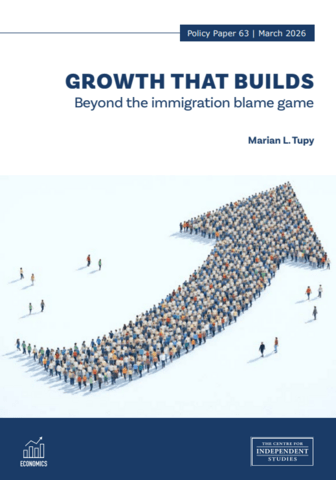
Immigration and housing affordability have become politically inseparable in contemporary Australia. This paper argues that Australia’s housing crisis is primarily a supply failure, not simply a population issue. It examines international and Australian evidence on migration and housing markets, including research on zoning restrictions, supply elasticity, and labour bottlenecks in construction. It also considers the role of skilled migration in strengthening the productive capacity of the economy – particularly in the very occupations needed to design, approve and build more homes.
The central point is straightforward. Australia does not face a binary choice between skilled migration and affordable housing. It faces a policy choice between maintaining restrictive land-use systems that convert growth into scarcity or reforming those systems so that population growth can be absorbed through construction rather than capitalised into higher prices. In short, the housing shortage is not an inevitable consequence of migration. It is the predictable result of constrained supply.
The report points to major zoning reforms in Auckland, New Zealand, as a real-world example of what happens when governments allow building at scale. After upzoning most of the city, Auckland saw a substantial lift in construction and rents that were significantly lower than they otherwise would have been.
The report calls for a practical reform agenda, including:
- protecting and expanding skilled migration pathways, particularly for occupations tied to housing delivery
- reforming state and local planning systems to reduce artificial land scarcity and shorten approval times
- aligning migration settings with construction capacity goals
- measuring success by housing completions, rental growth and approval times, not by headline migration numbers alone.
The report is provided with an audio version.
