

Organisation
Department of Communities and Justice (NSW)
Owning Institution:
Website:

Evaluation
Specialist workers for children and young people outcomes evaluation: final report
The Specialist Workers for Children and Young People (SWCYP) identifies accompanied children and young people in priority refuges who require specialist support because they have experienced or are experiencing domestic and family violence and are homeless or at risk of homelessness. This evaluation shows the service is achieving positive outcomes for children and young people...
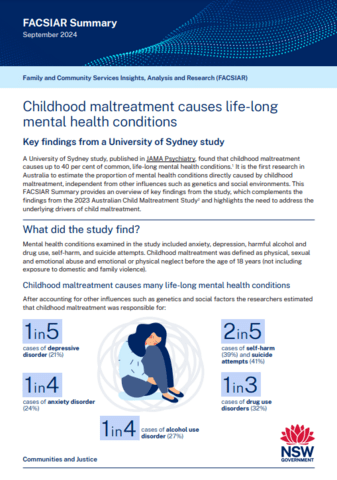
Research Summary
Childhood maltreatment causes life-long mental health conditions
This summary presents findings from research that estimates that childhood maltreatment causes up to 40 percent of common mental health disorders and highlights the need to address the underlying drivers of child maltreatment.
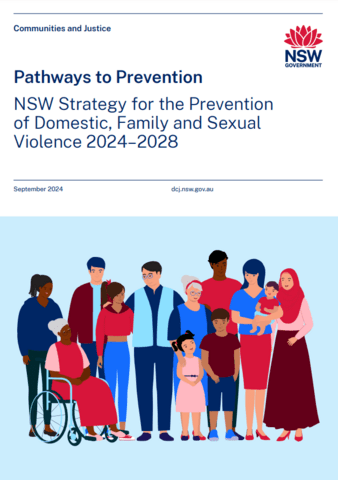
Strategy
Pathways to prevention: NSW strategy for the prevention of domestic, family and sexual violence 2024–2028
This is New South Wales' first dedicated whole-of-government domestic and family violence, and sexual violence primary prevention strategy. It provides a coordinated approach to strengthen primary prevention work and draws on the diverse expertise and place-based knowledge of the NSW community sector.
Report
Outcomes for children and young people in non-government organisations managed out-of-home care
This paper presents findings from the first large-scale prospective longitudinal study of children and young people in out-of-home care (OOHC) in Australia, comparing the socio-emotional outcomes of government- and non-government-managed care. It notes a range of factors that influence wellbeing but finds no evidence that the case management provider has a significant impact.
Report
Leaving care cohort (15-17 years) statistical report: experiences of young people who entered out-of-home care aged 4-14 years
This report focuses on a cohort of young people in out-of-home care (OOHC) who were aged 15-17 years at the time of their interview and describes the experiences of young people who entered OOHC when they were 4-14 years old. It focuses on the demographic characteristics, socio-emotional wellbeing, social competence, verbal ability, non-verbal reasoning and...