

Legal services
Alternative labels
Legal aid
Legal information
Legal assistance to the poor
Legal assistance services
Judicare
Legal assistance programs
Report
Attracting and retaining criminal lawyers in Tasmania
This report presents the findings of a research project to explore the factors influencing recruitment and retention of criminal lawyers in Tasmania. The report includes 20 recommendations and options for measures that one or more stakeholders could take to address attraction and retention issues and improve the supply of criminal lawyers in Tasmania.

Report
Measure for measure: a people-centred approach to tailoring justice
This report identifies common elements of effective practice across a range of Victorian justice initiatives and organises them into a People-Centred Justice Model to help inform how the sector designs, measures and understands its work. The report also explores the potential and challenges in sustaining and scaling these initiatives.
Report
Barriers experienced by Aboriginal and Torres Strait Islander children and families accessing legal supports
This study sets out evidence-based reforms to reduce Aboriginal and Torres Strait Islander child removals and strengthen child protection and justice systems. It aims to identify opportunities and options to address systemic discrimination and barriers, improve legal and related supports, and reduce the over-representation of Aboriginal and Torres Strait Islander children in out-of-home care.
Report
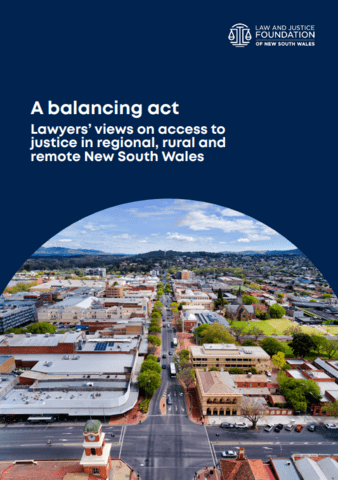
A balancing act: lawyers’ views on access to justice in regional, rural and remote NSW
Justice delivery in regional, rural and remote NSW is shaped by distance, local context and community needs. Drawing on practitioner insights, the research explores how legal services function, the barriers and supports affecting access to justice, and the potential for technology to improve service delivery and meet the legal needs of these communities.
Guide
Toolkit for access to justice and people-centred justice systems
Drawing on global evidence, case studies and good practice, the Toolkit provides governments, justice institutions and practitioners with practical guidance to make justice more responsive to people’s needs. Structured around five pillars – purpose and culture, service design and delivery, governance infrastructure, people’s empowerment, and evidence-based planning – the Toolkit offers self-assessment questions, checklists and...