

Report
 SHARE
SHARE
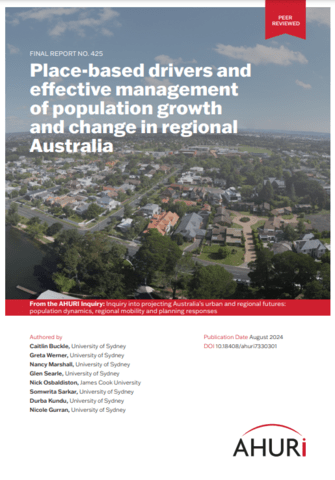
Place-based drivers and effective management of population growth and change in regional Australia
Nick Osbaldiston, Somwrita Sarkar, Durba Kundu, Nicole Gurran
Publisher
Regional planning
Regional economics
Population growth
Internal migration
Rural and remote communities
Australia
Resources

Description
This study examines the place-based factors that influence people moving to and from Australian regional and rural areas and considers policy solutions for managing the impacts of this change.
Key findings
- Modelling of population change reveals that larger tourism sectors and more graduates in the workforce, as well as increased airport services, are associated with higher population growth in non-metropolitan Australia, while higher dwelling prices have a negative effect on growth. Favourable geographic factors for growth are proximity to the coast and metropolitan cities, and a warmer and wetter climate.
- Respondents to community surveys noted different reasons for moving to selected case study areas, with ‘lifestyle reasons’ selected most by those who had moved to Port Macquarie Hastings, ‘personal reasons’ for movers to Ballarat and ‘employment reasons’ for Broken Hill. Cheaper housing and lifestyle were increasingly important reasons for moving from capital cities to all case study areas within the last five years.
- The likelihood of population churn was high across all case study areas, with the highest number of survey respondents stating they were likely to move away in the next five years coming from Broken Hill (44% of respondents).
- Poor or inadequate secondary education and tertiary training, health and disability services, crime rates, climate and rising housing costs or lack of availability were stated in interviews as place-based factors for moving from the case study areas.
- Policies to support liveability, such as improvements to housing affordability and availability, local health and education services, and local transport infrastructure, as well as funding for regional airports, universities and TAFE campuses could aid population growth and retention.
- Coordination across tiers and departments of local, state and federal government and industry is essential to deliver successful place-based solutions to encourage and manage population growth in regional cities.
Publication Details
Peer Reviewed:
Yes
DOI:
10.18408/ahuri7330301
ISBN:
978-1-922498-93-9
Copyright:
Australian Housing and Urban Research Institute Limited 2024
License type:
CC BY-NC
Access Rights Type:
open
Series:
Final Report No. 425
Post date:
8 Aug 2024
