

Report
 SHARE
SHARE
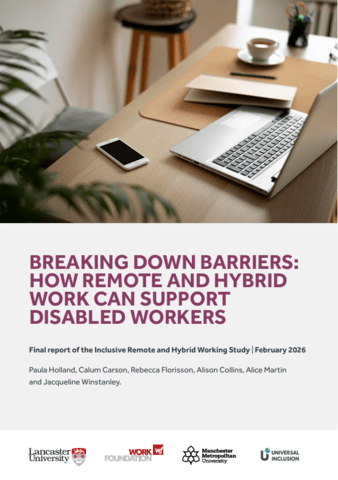
Breaking down barriers: how remote and hybrid work can support disabled workers
Final report of the Inclusive Remote and Hybrid Working Study
Jacqueline Winstanley
Publisher
Labour supply
Labour force participation
Flexible work
Employer engagement (disability)
Chronic diseases
Disability inclusion
People with disability
United Kingdom

Description
This report finds that six years on from Covid-19, access to remote and hybrid work has become essential to many people who are disabled or have long-term health conditions. The report describes the findings of a UK-wide survey of people with disability and in-depth interviews with survey participants and employers. Most of the disabled people who participated reported a strong preference for continuing to work remotely or in a hybrid way, and positive impacts on their health, employment and personal circumstances.
Key findings
- 46% of participants wanted to work remotely all the time and there was also demand for hybrid working.
- Women, carers and people with multiple or severely limiting impairments/health conditions were particularly likely to report they only wanted to work from home.
- 85% of participants said that having access to remote/hybrid working would be essential or very important if looking for a new job.
Policy recommendations
- Expand access to remote and hybrid jobs by making these and other forms of flexible working a core part of efforts to increase disabled people’s employment.
- Encourage employers to advertise flexibility upfront.
- Address regional inequalities in access to hybrid work.
- Strengthen reasonable adjustments, ensuring employers properly consider remote and hybrid working.
- Improve accountability, including requiring large employers to report on outcomes for disabled workers.
Publication Details
Copyright:
The authors 2026
Access Rights Type:
open
Post date:
14 May 2026
Collections
More like this
