

Report
 SHARE
SHARE
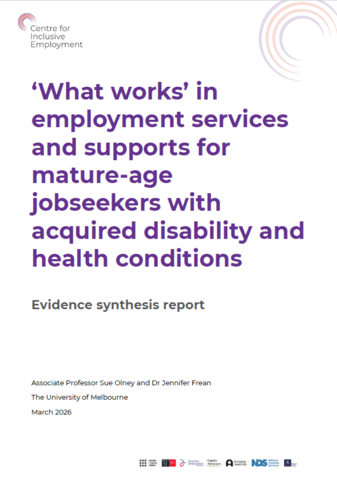
‘What works’ in employment services and supports for mature-age jobseekers with acquired disability and health conditions
Evidence synthesis report
Publisher
Employment services
Disability employment services
Flexible work
Disability employment
Mature-age workers
Unemployment
Barriers to work
Chronic diseases
Disability inclusion
Physical disability
People with disability
Australia
Resources
| Attachment | Size |
|---|---|
 Evidence synthesis report (PDF) Evidence synthesis report (PDF)
|
721.1 KB |
|
Evidence synthesis report (Word)
|
440.57 KB |
|
Evidence synthesis resource list (PDF)
|
433.56 KB |
|
Evidence synthesis resource list (Word)
|
338.73 KB |
Description
This report reviews Australian and international evidence to synthesise ‘what works’ in employment services and supports to move unemployed people aged over 45 with disability and health conditions into work, and what could work better in the current landscape to improve the quantity and quality of employment outcomes for that group in Australia.
It finds varied work capacity, structural barriers, and limited scalable success. Compliance-driven models underperform, while effective approaches prioritise employer engagement, inclusive and flexible job design, and coordinated supports to improve employment outcomes.
Key findings
- Australian labour force data and employment services caseload data suggests that current efforts to keep people aged over 45 attached to the labour market when their capacity to work changes due to disability or ill-health, or to help them return to work after their career is disrupted, are misdirected.
- Robust local evidence of ‘what works’ remains scarce in terms of employment services and supports successfully helping people aged 45-64 with acquired disability and health conditions find and keep work at scale or in different contexts.
- Existing research relates to groups of jobseekers that overlap with, but do not directly align with all, characteristics of interest for this report (Australian jobseekers aged 45-64 with acquired disability and health conditions).
- This report synthesises the evidence providing insights and examples of success in improving employment outcomes for people aged over 45 with acquired disability from Australia and overseas.
- The evidence calls for employment services to work closely and strategically with employers to build inclusive workplaces and flexible employment opportunities for jobseekers with diverse skills and needs in ways that explicitly add value to the employer’s business.
- Evidence suggests that if employment services help employers to reconceptualise their workforce and give them the tools and support they need to successfully hire and retain workers with diverse skills and needs, that is likely to increase employment outcomes for jobseekers aged over 45 with acquired disability and health conditions on their caseloads in spite of structural constraints beyond their control.
The report is accompanied by a summary and evidence synthesis resource list.
Related Information
Publication Details
DOI:
10.60836/v5h5-t013
Copyright:
Commonwealth of Australia 2026
License type:
CC BY-NC-ND
Access Rights Type:
open
Post date:
27 Apr 2026
