

Federal government
Briefing paper
Economic Reform Roundtable: issues papers
Three issues papers covering each of the themes of the Australian Government’s Economic Reform Roundtable: economic resilience, productivity, and budget sustainability and tax reform. They define the issues, set out recent trends and outline the big challenges and opportunities Australia is confronting.
Report
Digital government in Australia: enhancing digital investment
This report reviews Australia's' Digital and ICT Investment Oversight Framework (IOF) progress three years post-launch, benchmarking it against OECD best practice. It identifies strengths, challenges and opportunities to ensure the IOF remains fit for purpose and continues to advance Australia’s digital government ambitions. Based on the assessment, the report provides policy recommendations for the Australian...
Report
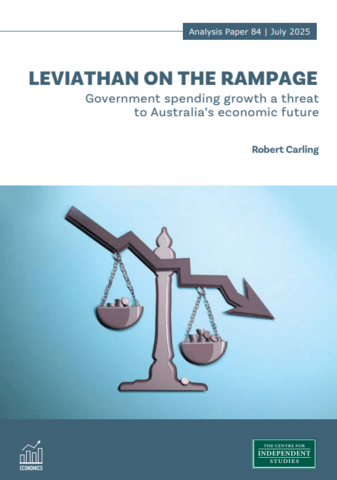
Leviathan on the rampage: government spending growth a threat to Australia’s economic future
Australia’s government expenditure has surged to a post-war high of 38%–39% of GDP. The growth of government spending is a serious economic concern because of what it means for persistent budget deficits, rising public debt and taxation, weak productivity growth and the societal consequences of a deepening dependency on government. This report calls for immediate...

Position paper
A seat at the table: embedding transparency, integrity, and equality into the federal lobbying regime
This paper examines the central shortcomings of the Australian regime for regulating lobbying and proposes comprehensive reform to address them. It calls on the federal government to work towards re-building trust with the public by prioritising transparency, integrity and equality in lobbying. The paper proposes comprehensive legislative reform is urgently recommended. It provides 15 recommendations.
Discussion paper
GST reform: how to stop the states being shortchanged
The Goods and Services Tax (GST) was supposed to grow over time, so that state and territory governments would have a reliable income source to help them fund important services. This paper finds that if the GST had kept up with economic growth, states and territories would have received an additional $231 billion in revenue.